
Most smokers know nicotine is what keeps them smoking. Fewer know how much nicotine is in a cigarette, how much actually reaches the brain, or why cigarettes deliver it so effectively. Understanding this makes it easier to choose the right support when you quit smoking.
By Jean-François Etter, professor of public health.
How much nicotine is in a cigarette?
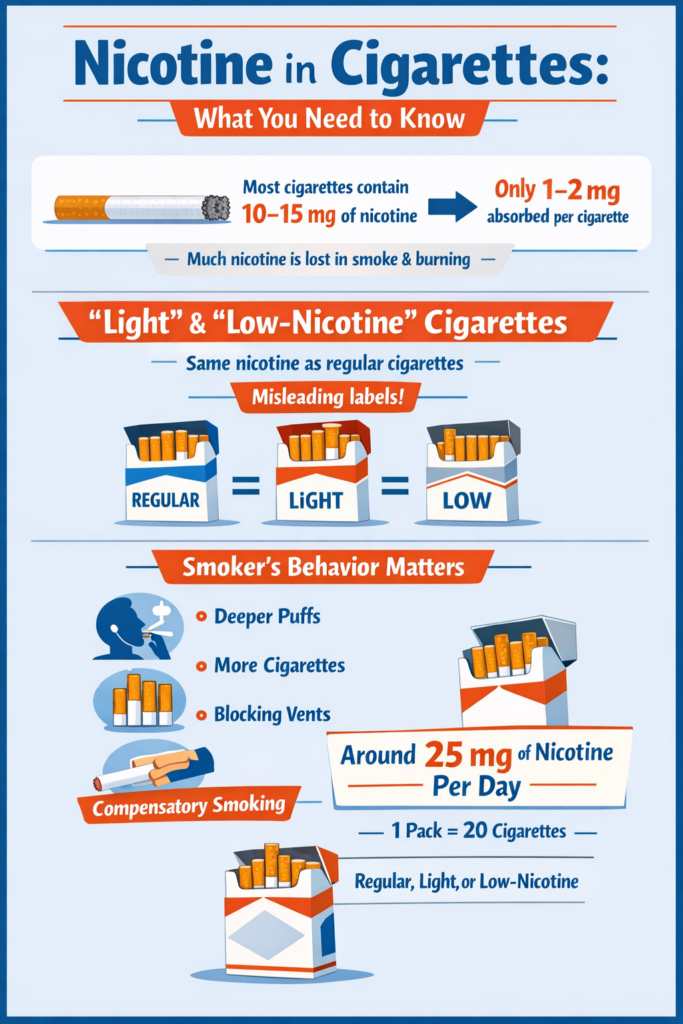
Most commercial cigarettes contain about 10 to 15 mg of nicotine in the tobacco. You don’t absorb all of that. Much of it is destroyed by burning, left in the butt, or lost in the smoke that drifts away between puffs. A typical smoker absorbs about 1 to 2 mg per cigarette. That may sound small, but it is enough to create and maintain nicotine addiction.
Why cigarettes are so addictive
Speed of delivery is the key factor. Inhaled nicotine reaches the brain within about 10 seconds, triggering a release of dopamine that feels rewarding or calming. Nicotine then clears from the body fairly quickly, and levels fall by half within about 90 minutes, and withdrawal symptoms such as irritability, cravings and poor concentration begin to build. The next cigarette relieves them, and the cycle repeats. Over time the brain adapts and comes to expect regular doses.
Manufacturers have also designed cigarettes to make nicotine delivery fast and reliable, through tobacco blending, chemical additives that make the smoke easier to inhale, and by spraying nicotine on tobacco during manufacture.
“Light”, “mild” and “low-nicotine” cigarettes
Cigarettes once sold as “light”, “mild” or “low nicotine” (labels now banned in many countries) contain about as much nicotine in the tobacco as regular ones. They produce lower nicotine yields on testing machines because tiny ventilation holes near the filter dilute the smoke, but smokers don’t smoke like machines. Because the brain wants its usual dose, people who smoke these cigarettes tend to compensate by:
- taking deeper or longer puffs,
- smoking more cigarettes, and
- covering the vent holes with their fingers or lips.
The result is that they get a roughly similar dose of nicotine and the same toxic smoke for regular and “light” cigarettes.
Genuinely very-low-nicotine cigarettes (VLNC), which contain almost no nicotine in the tobacco, are different. In research trials they have reduced dependence and the number of cigarettes smoked, which is why some governments are considering limits on nicotine content, but this policy is controversial, because some experts think that people will not use VLNC in the long term. They are not widely available, and they are not a safe cigarette either, since the smoke is still harmful.
Nicotine is addictive, but smoke is what does most of the damage
Nicotine isn’t harmless. It is addictive, it temporarily raises heart rate and blood pressure, and it should be avoided in pregnancy unless a doctor advises otherwise. But the cancers, lung diseases and heart diseases caused by smoking comes from burning tobacco and inhaling smoke: tar, carbon monoxide and thousands of other chemicals. This is why delivering nicotine without smoke is much safer than smoking, and why it can help you stop smoking.
What can help you quit smoking?
Nicotine replacement therapy (NRT) in the form of patches, gum, lozenges, tablets, inhalers or sprays gives you nicotine at a slower, steadier rate than a cigarette, without the smoke. This relieves cravings and withdrawal while you break the habit. Because nicotine is absorbed gradually rather than hitting the brain within seconds, NRT has a much lower potential for dependence than cigarettes, though a small number of people do continue using nicotine gums for longer than planned. Nobody is addicted to the nicotine patch, because of its very slow nicotine delivery.
- Combination NRT works better. Using a patch for steady background nicotine plus a fast-acting form (gum, lozenge or spray) for sudden cravings improves the chances of quitting compared with a single product.
- Dose matters. Heavier smokers (for example those who smoke 10 or more cigarettes a day, or light up within 30 minutes of waking) usually need a higher-strength patch or gum. Too little nicotine is a common reason for relapse. A pharmacist or doctor can help you choose the best product and the right dosage.
- Prescription medicines such as varenicline and cytisine / cytisinicline reduce cravings and the reward from smoking, and in studies they are among the most effective options. Bupropion is another choice. Availability varies by country.
- Nicotine e-cigarettes have helped many people stop smoking, and recent reviews suggest they are more effective than NRT and as affective as varenicline. They are much less harmful than cigarettes, but not risk-free, and long-term effects are still being studied. They are intended for smokers who want to quit, not for non-smokers.
- Nicotine pouches have been studied less, and rules on their sale differ between countries.
- Support increases success. Counselling, quitline calls and peer groups help with the habits, routines and emotions linked to smoking, and work well alongside medication.
Find out how much nicotine you need
Take our quiz to estimate how much nicotine you inhale (or inhaled) as a smoker, and what dosage of nicotine suits you best.
What to expect after quitting
Withdrawal symptoms usually peak within the first weeks and then ease. These include cravings, irritability, trouble sleeping, difficulty concentrating and increased appetite and weight gain. These symptoms are attenuated by nicotine medications. Cravings come in waves that pass, even if you do nothing. Slips happen and are not failure. Many people need more than one attempt, and each attempt teaches you something.
Talk to a professional if you…
- are pregnant or breastfeeding,
- have heart disease, or
- take regular medication or have a medical condition.
Most people can safely use NRT, and the risks of continuing to smoke are far greater, but a doctor or pharmacist can tailor advice to you.
Rate this article by clicking on the desired number of stars:
Please use the “Comments” field below to share your experience or suggest improvements to this article.
References:
Theodoulou A, Chepkin SC, Ye W, Fanshawe TR, Bullen C, Hartmann-Boyce J, Livingstone-Banks J, Hajizadeh A, Lindson N. Different doses, durations and modes of delivery of nicotine replacement therapy for smoking cessation. Cochrane Database of Systematic Reviews 2023, Issue 6. Art. No.: CD013308. https://doi.org/10.1002/14651858.CD013308.pub2
Djordjevic, M.V., Doran, K. . (2009). Nicotine Content and Delivery Across Tobacco Products. In: Henningfield, J.E., London, E.D., Pogun, S. (eds) Nicotine Psychopharmacology. Handbook of Experimental Pharmacology, vol 192. Springer, Berlin, Heidelberg. https://doi.org/10.1007/978-3-540-69248-5_3
Djordjevic, M.V., Doran, K. . (2009). Nicotine Content and Delivery Across Tobacco Products. In: Henningfield, J.E., London, E.D., Pogun, S. (eds) Nicotine Psychopharmacology. Handbook of Experimental Pharmacology, vol 192. Springer, Berlin, Heidelberg. https://doi.org/10.1007/978-3-540-69248-5_3
Martin J. Jarvis, Richard Boreham, Paola Primatesta, Colin Feyerabend, Andrew Bryant, Nicotine Yield From Machine-Smoked Cigarettes and Nicotine Intakes in Smokers: Evidence From a Representative Population Survey, JNCI: Journal of the National Cancer Institute, Volume 93, Issue 2, 17 January 2001, Pages 134–138, https://doi.org/10.1093/jnci/93.2.134
Malson JL, Sims K, Murty R, et al. Comparison of the nicotine content of tobacco used in bidis and conventional cigarettes. Tobacco Control 2001;10:181-183. https://doi.org/10.1136/tc.10.2.181




Leave a Reply