
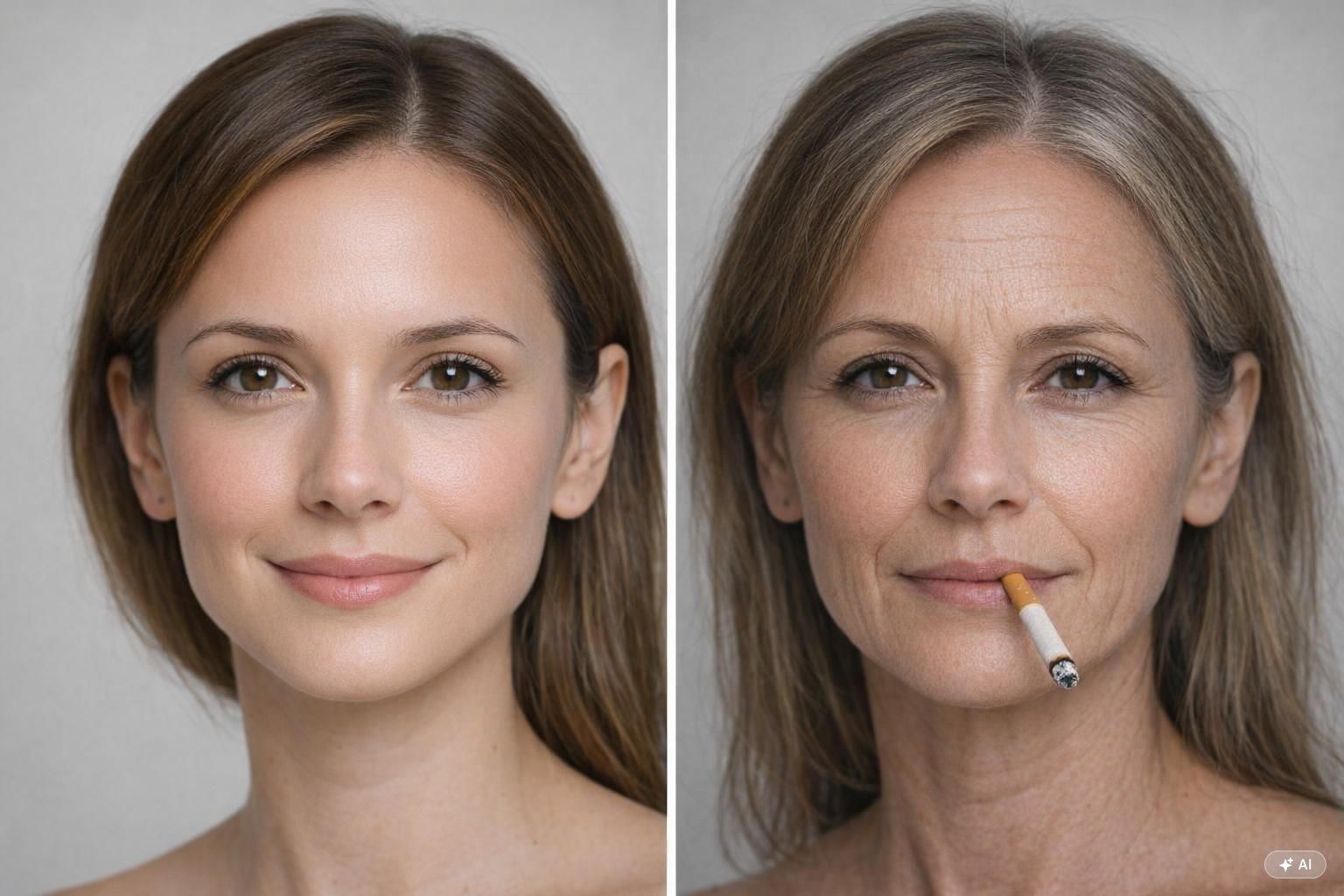
One of the most visible and immediate effects of smoking is seen directly on the skin, the body’s largest organ, which suffers a relentless impact with every cigarette smoked. From fine lines that deepen around the mouth to wounds that take longer to heal, smoking leaves its mark on skin health, far beyond a mere cosmetic issue
The Smoker’s Face: Wrinkles and Lines
Dermatologists have long recognised a distinct constellation of facial features associated with long-term smoking, sometimes referred to informally as “smoker’s face.” This includes deep vertical lines radiating from the upper and lower lips (a direct consequence of the repeated pursing motion of drawing on a cigarette) along with crow’s feet, hollowed cheeks, and a general gauntness that makes a person appear older than their age.
Studies have consistently shown that smokers develop wrinkles earlier and more severely than non-smokers even after controlling for sun exposure. The effect is dose-dependent: the more cigarettes smoked per day and the more years a person has smoked, the more pronounced the skin aging becomes.
How Smoking Ages the Skin
The skin owes its firmness, elasticity, and youthful appearance largely to two proteins: collagen and elastin. Collagen provides structural support and tensile strength, while elastin allows the skin to snap back after being stretched or compressed. Together, they form the scaffolding that keeps skin looking plump and resilient.
Smoking disrupts both of these proteins through several interconnected pathways.
Oxidative stress is one of the primary culprits. Cigarette smoke contains thousands of chemical compounds, many of which are powerful oxidants. These molecules trigger the generation of free radicals (unstable atoms that damage cells by stealing electrons from surrounding molecules). The skin’s antioxidant defences, including vitamins C and E, are rapidly depleted in smokers, leaving cells exposed to oxidative damage. This accelerates the breakdown of collagen fibres and impairs the body’s ability to synthesise new ones.
Smoking also activates matrix metalloproteinases (MMPs), a family of enzymes responsible for breaking down extracellular matrix proteins, including collagen. Under normal circumstances, MMPs are tightly regulated and play a useful role in tissue remodelling. In smokers, however, they are chronically upregulated, meaning collagen is degraded faster than it can be replaced. The result is a progressive thinning and weakening of the dermal layer.
At the same time, nicotine causes vasoconstriction — the narrowing of blood vessels. The small capillaries that supply the skin with oxygen and nutrients are particularly vulnerable to this effect. Reduced blood flow means the skin receives less of what it needs to repair itself and maintain normal cellular turnover. Over time, this chronic ischaemia contributes to a dull, greyish complexion that many smokers develop, as well as impaired regeneration of skin cells.
Finally, smoking interferes with oestrogen metabolism, in women. Oestrogen plays an important role in maintaining skin thickness, moisture, and collagen content. Smokers tend to have lower circulating oestrogen levels, which partly explains why female smokers often experience more pronounced skin aging than their male counterparts.
Smoking and Sun Exposure
Ultraviolet (UV) radiation from the sun is the single greatest environmental cause of premature skin aging — a process known as photoaging. It damages DNA in skin cells, degrades collagen and elastin, and promotes the formation of pigmentation irregularities. Smoking and sun exposure do not simply add their effects together; evidence suggests they interact in ways that amplify skin damage beyond what either factor would cause alone.
Both smoking and UV radiation independently activate MMP enzymes and generate oxidative stress. When they occur together, the combined burden on the skin’s repair mechanisms is substantially greater. A person who smokes and spends significant time in the sun without protection is, in effect, attacking their skin from two directions simultaneously — depleting antioxidants, degrading structural proteins, and impairing cellular repair at an accelerated rate.
This synergy also has implications for skin cancer risk. While smoking alone is not as strongly associated with melanoma as sun exposure, it does appear to increase the risk of certain skin cancers, particularly squamous cell carcinoma. The immunosuppressive effects of smoking — discussed further below — may reduce the skin’s capacity to detect and destroy abnormal cells before they proliferate.
Wound Healing
One of the most clinically significant consequences of smoking on skin health is its profound impairment of wound healing. Surgeons have long known that smokers are at substantially higher risk of post-operative complications, including wound dehiscence (the reopening of a surgical incision), infection, and poor scar formation. This is not a minor statistical footnote — in some surgical contexts, smoking status is considered a meaningful risk factor that influences whether certain elective procedures should proceed at all.
The mechanisms behind this impairment are multiple and overlapping. Nicotine-induced vasoconstriction reduces the delivery of oxygen and nutrients to the wound site, both of which are essential for the proliferation of fibroblasts — the cells responsible for laying down new collagen during healing. Carbon monoxide, absorbed from cigarette smoke into the bloodstream, binds to haemoglobin and reduces its oxygen-carrying capacity, compounding this hypoxic effect.
The consequences of this impaired healing extend beyond surgical wounds. Everyday cuts, abrasions, and skin injuries take longer to resolve in smokers. Chronic wounds, such as venous leg ulcers, are more common and more difficult to treat. Even acne lesions and inflammatory skin conditions may persist longer due to the skin’s reduced capacity for self-repair.
Smoking and Infection
The skin serves as the body’s first line of defence against pathogens. Its integrity, its pH, and the immune surveillance carried out by resident immune cells all contribute to keeping bacteria, fungi, and viruses at bay. Smoking undermines this defence at several levels.
The immunosuppressive effects of smoking extend to the skin’s own immune architecture. Langerhans cells, which are specialised immune cells embedded in the epidermis and responsible for detecting foreign antigens, are reduced in number and function in smokers. This means that early-stage infections are less likely to be recognised and neutralised before they take hold.
Smokers have a higher incidence of certain skin infections, including candidiasis (fungal infection), and are more susceptible to bacterial skin infections following injury. The combination of impaired circulation, reduced immune surveillance, and slower wound healing creates conditions in which pathogens can establish themselves more easily and persist longer.
The Reversibility Question
The encouraging reality is that the skin does have a meaningful capacity to recover after smoking cessation. Blood flow to the skin begins to improve within weeks of quitting, and the gradual restoration of collagen synthesis means that skin quality can improve over time. The most dramatic improvements tend to occur in younger ex-smokers whose skin has had less cumulative exposure, but even long-term smokers report noticeable changes in skin tone and texture in the months and years following cessation.
The damage that has already occurred — particularly deep structural changes to collagen and elastin — cannot be fully reversed. But stopping smoking halts the ongoing degradation and gives the skin the best possible chance to repair and renew itself. Combined with good sun protection, adequate hydration, and a diet rich in antioxidants, the skin’s recovery after quitting can be genuinely significant.
Every cigarette not smoked is, in a very literal sense, a contribution to healthier skin — and to a face that reflects the age you actually are, rather than the toll of years of tobacco use.




Leave a Reply