
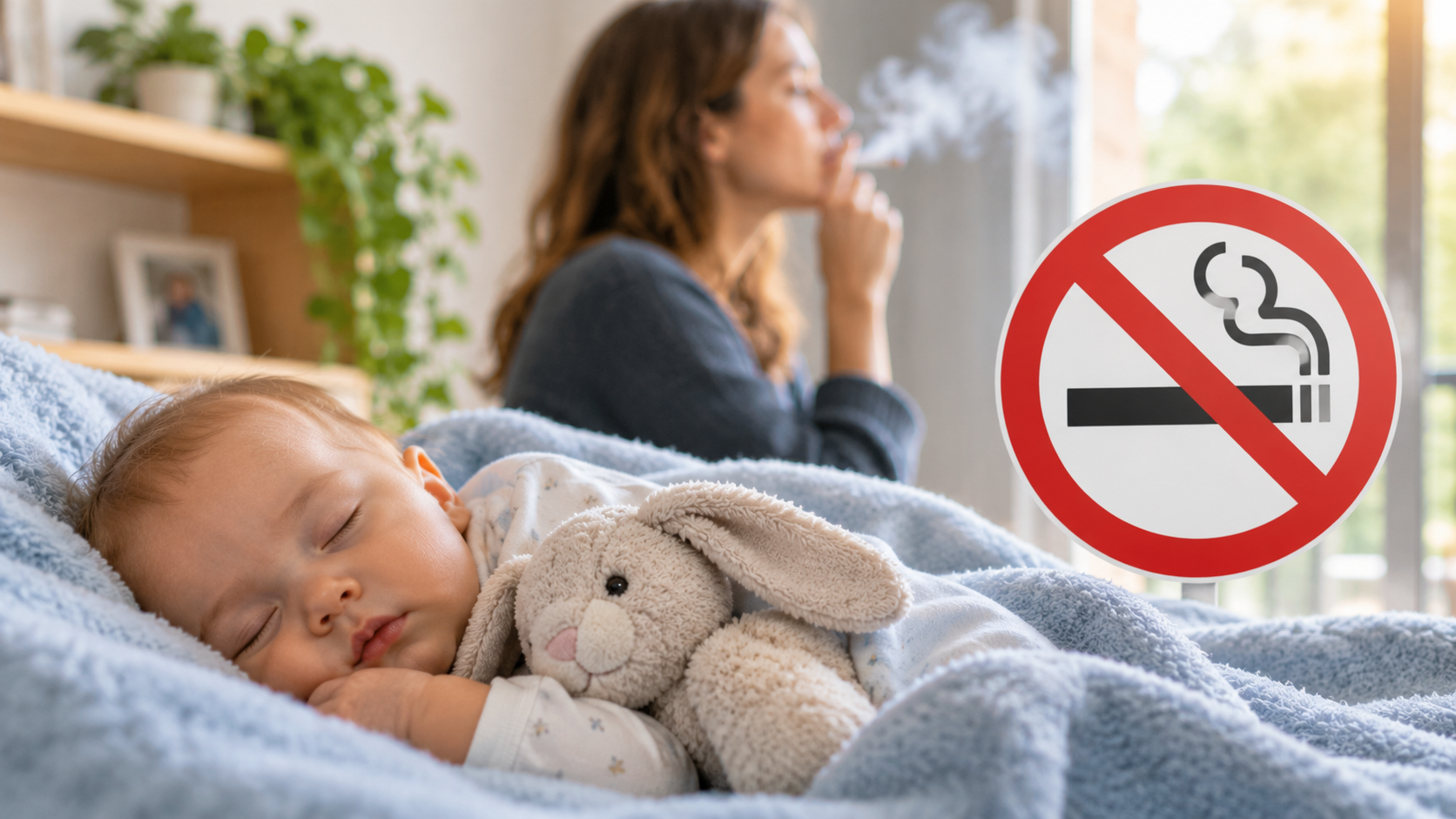
A baby cannot choose the air they breathe. When adults smoke around them, harmful substances from tobacco smoke can reach their lungs, even if the cigarette is smoked near an open window, on a balcony or in another room. For parents and caregivers, protecting a baby from second-hand smoke is one of the most important steps they can take to safeguard their health.
Why babies are particularly vulnerable
Babies breathe more rapidly than adults and their lungs and immune systems are still developing. Exposure to second-hand smoke can irritate their airways and affect their respiratory health. There is no safe level of exposure to tobacco smoke for infants.
Passive smoking increases the risk of respiratory infections, bronchitis, bronchiolitis, pneumonia and wheezing. It can also aggravate asthma symptoms in children who develop the condition. Exposure is associated with an increased risk of sudden infant death syndrome (SIDS).
These risks are not limited to the time when a cigarette is being smoked. Tobacco smoke contains a mixture of toxic substances that can remain in the air and settle on surfaces, furniture, clothing and other materials. This residue, sometimes called third-hand smoke, may also expose babies to harmful substances through contact with contaminated surfaces.
Opening a window is not enough
Many parents try to reduce the risks by smoking near a window, using an extractor fan or smoking in a separate room. These measures may reduce some exposure, but they do not eliminate it.
Smoke can travel through doorways, ventilation systems and other openings. It can also linger in indoor air. Air fresheners, candles and household ventilation cannot reliably remove the harmful substances in tobacco smoke.
The most effective protection is to keep the home and car completely smoke-free. Smoking should take place outside, away from doors, windows and the baby. A balcony or terrace may be preferable to smoking indoors, provided smoke does not drift back inside.
Protect your baby at home and in the car
A smoke-free environment needs to be maintained by everyone who spends time with the baby, not just the parents. This includes grandparents, babysitters, friends and other family members.
A few practical habits can make a real difference:
- Make the home smoke-free. Establish a firm rule that nobody smokes inside, regardless of whether the baby is present at the time.
- Keep the car smoke-free. Never smoke in a vehicle carrying a baby, even with the windows open or the child sitting in a car seat.
- Smoke outside. Move away from doors, windows and areas where the baby is sleeping or playing.
- Wash your hands after smoking. This helps reduce the transfer of tobacco residue to the baby’s skin and belongings.
- Change outer clothing when possible. Tobacco residues can cling to fabrics, so changing a smoking jacket or outer layer before holding the baby may help reduce exposure.
- Ask visitors to respect the rules. Explain calmly that smoking is not permitted in the home or around the baby.
These measures help reduce exposure, but washing hands or changing clothes cannot make smoking around a baby safe. The priority remains preventing smoke from reaching the child.
Breastfeeding and smoking: what should parents know?
Smoking can affect both the breastfeeding parent and the baby. Nicotine and other harmful substances can pass into breast milk, while smoking may also affect milk production.
If a parent smokes, quitting is the best way to protect both their own health and their baby’s health. However, smoking is not in itself a reason to stop breastfeeding. Breastfeeding has important benefits, and parents who are unable to quit immediately should seek professional advice to reduce exposure as much as possible.
Avoid smoking before breastfeeding whenever possible, and never smoke while feeding or holding the baby. If you are considering nicotine replacement therapy, speak with a healthcare professional about the most appropriate options during breastfeeding.
Quitting smoking is the best protection
The arrival of a baby can be a powerful reason to stop smoking, but quitting is not always easy. Nicotine dependence can make it difficult to break the habit, even when parents are fully aware of the risks.
Rather than relying on willpower alone, consider seeking support from a doctor, pharmacist or smoking cessation service. Counselling, behavioural support and, where appropriate, nicotine replacement therapy can improve the chances of quitting successfully.
Partners can also support one another by making the home smoke-free, avoiding smoking together and encouraging quit attempts without blame or pressure.
Protecting a baby from tobacco smoke is not about judging parents. It is about giving children the healthiest possible start in life. Every reduction in exposure matters, and making the home and car smoke-free is an important first step.
Please use the Comments field below to share your experience or to suggest improvements to this article.
Rate this article by clicking on the desired number of stars:
References:
Passive smoking and children. A report of the Tobacco Advisory Group of the Royal College of Physicians, published March 2010. https://shop.rcp.ac.uk/products/passive-smoking-and-children
Britton, John. “Passive smoking damages children’s health.” The Practitioner, vol. 254, no. 1729, May 2010, pp. 27+
Laura J. Rosen, Michal Ben Noach, Jonathan P. Winickoff, Mel F. Hovell; Parental Smoking Cessation to Protect Young Children:A Systematic Review and Meta-analysis. Pediatrics January 2012; 129 (1): 141–152. 10.1542/peds.2010-3209 https://doi.org/10.1542/peds.2010-3209
Jones, L.L., Hashim, A., McKeever, T. et al. Parental and household smoking and the increased risk of bronchitis, bronchiolitis and other lower respiratory infections in infancy: systematic review and meta-analysis. Respir Res 12, 5 (2011). https://doi.org/10.1186/1465-9921-12-5