

Secondhand smoke remains one of the most underestimated health threats in modern households. Unlike the deliberate choice smokers make when lighting a cigarette, those around them—spouses, children, and guests—have no say in their exposure to toxic chemicals and carcinogens. Yet many families continue to navigate this invisible danger with little understanding of the real risks involved or how to address the problem.
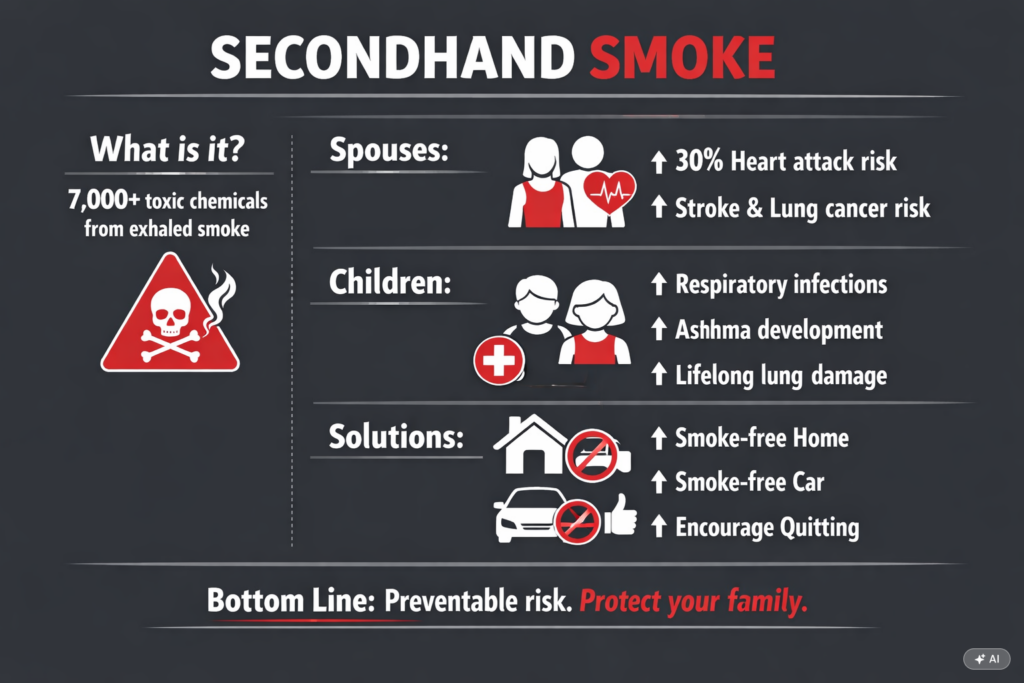
The science is clear. When a person smokes, they exhale a mixture of mainstream smoke and exhaled air, which combines with secondhand smoke to form environmental tobacco smoke, which contains more than 7,000 chemical compounds, hundreds of which are toxic and about 70 of which can cause cancer. The Environmental Protection Agency has classified secondhand smoke as a Group A carcinogen—the same category as asbestos and radon—placing it among the most dangerous substances found in homes.
The Toll on Spouses and Partners
Living with a smoker exposes a non-smoking spouse to the equivalent of smoking several cigarettes daily, even without ever lighting one themselves. Research consistently shows that spouses of smokers face significantly elevated risks of heart disease, stroke, and lung cancer. A study published in the journal Circulation found that non-smokers exposed to secondhand smoke at home had a 30 percent increased risk of heart attack compared to those in smoke-free homes.
The damage occurs silently and progressively. Secondhand smoke damages the lining of blood vessels, reduces oxygen in the blood, and increases the likelihood of blood clots. Over time, these effects accumulate, creating conditions for serious cardiovascular events. Women appear particularly vulnerable, with some studies suggesting even higher risks for female non-smokers in relationships with smokers.
Beyond the physical health impacts, many spouses report emotional strain. The constant exposure to smoke, despite requests to quit or smoke outside, can breed resentment and feelings of helplessness. Partners often find themselves caught between concern for their loved one’s health and frustration at being unable to protect their own.
The Particular Vulnerability of Children
Children face perhaps the most concerning risks from secondhand smoke exposure. Their lungs are still developing, their immune systems remain immature, and they spend more time in the home environment than adults. A child living with a smoker absorbs secondhand smoke continuously throughout the day and night.
The consequences are measurable and severe. Children exposed to secondhand smoke suffer higher rates of ear infections, respiratory infections, asthma development, and asthma exacerbation. They experience more coughing, wheezing, and shortness of breath. Some studies suggest that children of smokers miss more school days due to illness than their peers from smoke-free homes.
The risks extend beyond immediate respiratory concerns. Secondhand smoke exposure in childhood has been linked to reduced lung function that may persist into adulthood, even if the child is never exposed to smoke as a teenager or adult. Additionally, children living with smokers face increased risks of sudden infant death syndrome, if an infant is present, and developmental delays in some cases.
Perhaps most troubling is the modeling effect. Children who grow up in smoking households are significantly more likely to become smokers themselves, perpetuating a cycle of addiction and health consequences across generations.
Navigating Family Dynamics
Addressing smoking within a family requires sensitivity, firmness, and realistic expectations. Many people hesitate to confront a family member about smoking, fearing conflict or seeming judgmental. Yet remaining silent means accepting ongoing health risks for oneself and one’s children.
Starting a conversation requires choosing the right moment and framing the discussion around health rather than judgment or control. Rather than attacking the smoker’s choice, focus on the impact on family members. Phrases like “I’m worried about my health because of the smoke in our home” or “I want our children to grow up in a healthy environment” open dialogue without immediately triggering defensiveness.
Some families find success with compromise solutions initially. Designating smoking areas outside the home, away from doors and windows, reduces but does not eliminate secondhand smoke exposure. Improved ventilation through air purifiers can help, though no amount of ventilation completely removes secondhand smoke from indoor air. These measures work best as stepping stones toward complete smoke cessation rather than permanent solutions.
In cases where a family member refuses to quit or even reduce smoking, establishing firm boundaries becomes necessary. This might mean designating certain areas of the home as completely smoke-free, such as children’s bedrooms or the family car. It might mean limiting visits or requiring smokers to change clothes and wash hands before holding an infant. These boundaries, while sometimes difficult to enforce, communicate clearly that the health and comfort of non-smokers matter.
Practical Steps to Reduce Exposure
For those unable to convince a household member to quit immediately, several measures can minimize secondhand smoke exposure. The most effective is creating a completely smoke-free home, but when that proves impossible, establishing smoke-free zones—particularly children’s bedrooms and sleeping areas—provides some protection during vulnerable hours.
Ventilation helps but has limits. Opening windows or using exhaust fans removes some smoke but cannot eliminate it entirely, particularly in smaller spaces or during cold weather when windows remain closed. Air purifiers equipped with HEPA and activated charcoal filters capture some particles and odors but cannot filter out all gaseous components of secondhand smoke.
In vehicles, the situation is even more critical. A single cigarette smoked in a car exposes passengers to secondhand smoke concentrations far exceeding those found in homes, even with windows open. Many families find that establishing a strict no-smoking policy in the car becomes a crucial boundary for protecting children during transit.
Regular cleaning can reduce the accumulation of thirdhand smoke—the toxic residue that settles on surfaces and can be reactivated into the air. Washing bedding frequently, vacuuming with HEPA filters, and wiping down surfaces where smoke settles helps somewhat, though this approach addresses symptoms rather than the underlying problem.
Solutions
For those seeking to reduce their exposure, the most effective long-term strategy remains encouraging the smoker to quit. Resources exist, from nicotine replacement therapies to counseling services to support groups. Framing smoking cessation not as giving up something valued but as gaining health, freedom, and the ability to protect loved ones can sometimes shift perspective.
Until that happens, families must take whatever protective measures they can while continuing to advocate for complete smoke cessation. No child should grow up breathing secondhand smoke. No spouse should accept health risks to avoid conflict. The conversation may be difficult, but the alternative—silent, ongoing harm to those we love—is far worse.
Use the ‘Comments’ field below to share your experience or to suggest improvements to this page.




Leave a Reply