

After quitting smoking, most people gain weight. Here we explain why this happens, how much weight people usually gain after quitting, the possibility of using nicotine medications to delay weight gain, and how to limit weight gain
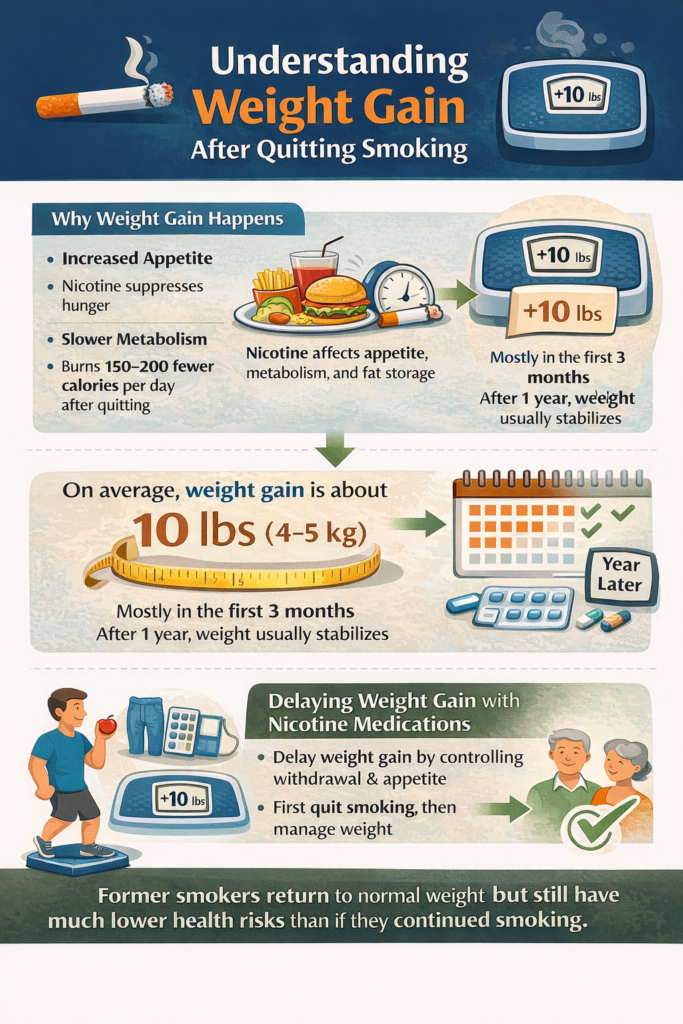
Why people gain weight after they quit
There are three main reasons why your body tends to put on a few pounds when you stop smoking, linked to the effects of nicotine on your appetite and metabolism. Together, these three factors influence your calorie balance (intake/expenditure) and storage in the form of body fat.
Increased appetite and cravings:
Nicotine acts as a mild appetite suppressant. When you remove it, you may feel hungrier more often. Increased appetite is a well-documented nicotine withdrawal symptom.
Many people also mistake the craving for a cigarette for a craving for food. Reaching for a snack is often an unconscious way to deal with the urge to put something in your mouth (the “hand-to-mouth” habit).
Food, especially sugary or fatty treats, releases brain chemicals that feel good, temporarily replacing the pleasure you got from nicotine.
Slower metabolism:
Smoking actually speeds up your metabolism (the rate your body burns calories). A smoker’s body burns about 150 to 200 more calories per day than a non-smoker’s.
When you quit smoking, your metabolism slows down to a normal, healthy rate, meaning you burn fewer calories at rest. If you don’t adjust your eating, those unburned calories can lead to weight gain.
Changes in how your body handles fat:
Nicotine affects how your body processes and stores fat. Quitting can lead to a shift in your body’s fat storage that contributes to weight gain.
How much weight can you expect to gain?
The good news is that the weight gain is usually modest. On average, most people who quit smoking gain about 10 pounds (4-5 kg). About one in ten people may gain more than 30 pounds, but this is the exception, not the rule. Most of this weight gain occurs within the first three months after quitting, and weight usually stabilises after about a year.
Remember, even with a 10-pound gain, your risk of heart disease and cancer is still significantly lower than if you continued to smoke.
How to use nicotine medications to delay and limit weight gain
Increased appetite and weight gain are nicotine withdrawal symptoms, and you can delay them as long as you take a sufficient dose of nicotine. Of course, it is preferable to use nicotine medications (patches, gum, lozenges, sprays or inhalers) which are harmless. By ‘delay’, we mean that you first stop smoking, then after 3 months of using nicotine medications, you can stop the nicotine treatment and only then will you gain weight. This two-step strategy allows you to deal with one problem at a time, first quitting smoking and managing withdrawal symptoms, then managing your weight.
Nicotine medications also make it easier to quit smoking by attenuating the other nicotine withdrawal symptoms: craving, iritability, depressed mood, anxiety, difficulty concentrating, difficulty sleeping.
But you have to accept the fact that, for most former smokers, weight gain is permanent. On average however, former smokers weigh the same as people who have never smoked, and current smokers weigh less than non-smokers. This means that, on average, former smokers simply return to the normal weight of non-smokers of the same age and gender. However, some former smokers gain a lot of weight and end up weighing more than is normal for their age.
We have created an entire website (Stop-Kilos.org) dedicated to helping people lose weight, so we invite you to visit the Stop-Kilos website for more information.
Is weight gain always a health problem?
Weight gain can lead to health problems mostly if you are overweight (body mass index, BMI>25 kg/m2) or obese (BMI >30 kg/m2) or if your waist circumference is >80 cm or >31.8 in (women) or >94 cm or 37 in (men). See our articles on how to measure your waist circumference and your body mass index.
Please rate this article by clicking on the desired number of stars: (1 votes, average: 5.00 out of 5)
 Loading...
Please use the Comments field below to share your experience and to suggest improvments to this page.




Leave a Reply