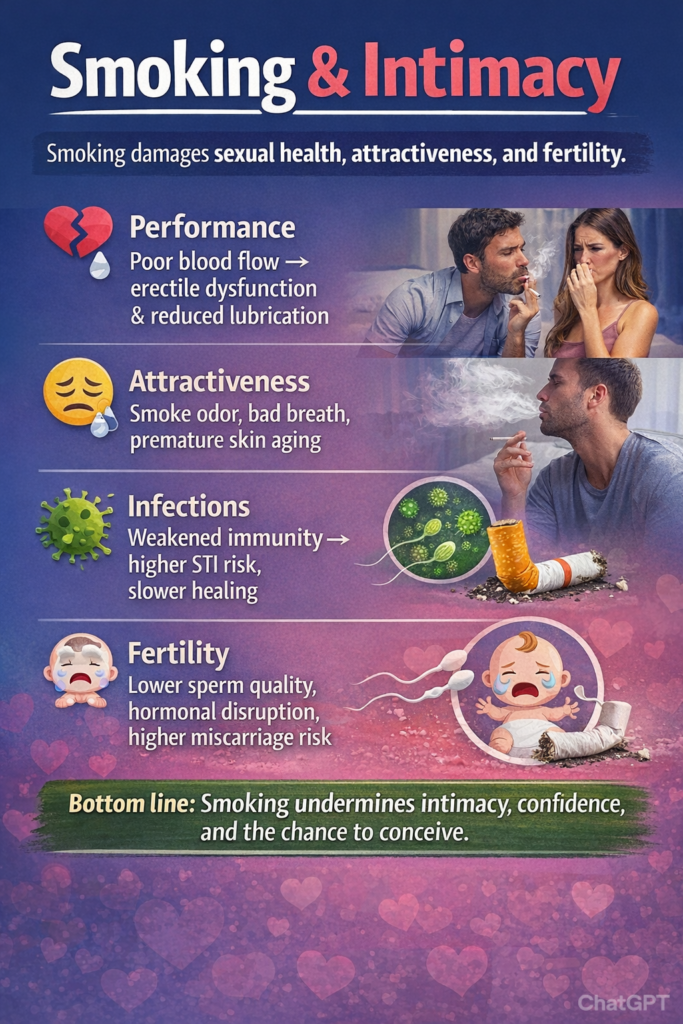

Few men make the connection between smoking and their sexual performance. Yet there is a well-established link between smoking and difficulty achieving and maintaining an erection (erectile dysfunction, ED). This is what motivates many smokers to quit smoking. Here is what scientific studies show, and what improves when you quit smoking.
How smoking damages erections
An erection is a vascular event. Sexual arousal triggers nerve signals that prompt the cells lining the penile arteries to release nitric oxide, a gas that relaxes smooth muscle and lets blood flood the erectile tissue. Anything that interferes with nitric oxide, or with the arteries themselves, interferes with erections.
Tobacco smoke does both. It contains thousands of chemicals, many of which generate oxidative stress, a kind of cellular wear that damages the endothelium, the thin layer lining blood vessels. Damaged endothelium produces less nitric oxide and breaks it down faster. Over years, smoking also drives atherosclerosis, the buildup of fatty plaque that narrows arteries.
Size matters here. The penile arteries are only a millimeter or two across, much narrower than the coronary arteries. A given amount of vascular damage can therefore show up as erectile trouble before it causes chest pain or any other symptom. Urologists and cardiologists have long noted that ED can precede heart disease by a few years, and some describe it as an early warning sign.
Other components of smoke add to the problem. Carbon monoxide binds to hemoglobin more readily than oxygen does, reducing the oxygen the blood can deliver. Nicotine stimulates the sympathetic nervous system, which tightens blood vessels and promotes contraction of the smooth muscle that has to relax for an erection to occur. Animal studies have also found structural changes in erectile tissue after prolonged exposure to smoke, including loss of smooth muscle and increased fibrous tissue. Whether smoking meaningfully lowers testosterone in men is less settled, and the evidence there is inconsistent.
How much higher is the risk?
A systematic review and meta-analysis pooled data from observational studies and found that current smokers had roughly 1.5 times the risk of ED compared with men who had never smoked. Risk generally climbs with the number of cigarettes per day and the number of years smoked, a dose-response pattern that strengthens the case for a causal link rather than a coincidence.
The effect is not confined to older men. ED is often assumed to be a problem of the 60s and 70s, but studies of younger men have found smoking to be one of the more consistent modifiable risk factors among those who develop ED in their 30s and 40s. Smoking also compounds other risks.
What happens when you quit
The same meta-analysis revealed that the risk among former smokers fell halfway between that of people who had never smoked and that of current smokers. Another synthesis found that population studies suggest that former smokers may not fully return to the same level of ED risk as non-smokers. However, smaller studies indicate that younger men (under 50) may have a better chance of improving erectile function after stopping smoking. Quitting early appears to offer the greatest chance of improvement. In men with severe cardiovascular disease and erectile dysfunction, however, the damage may be too advanced for quitting smoking alone to make a significant difference.
This is consistent with what we know about vascular recovery. Endothelial function begins to improve a few weeks after the last cigarette, and carbon monoxide clears from the blood within one or two days, but some damage may be permanent. Damage that has accumulated over several decades may not fully reverse, which is one argument for quitting sooner rather than later.
Quitting can also make ED treatment work better. Drugs such as sildenafil and tadalafil depend on the nitric oxide pathway, and men with healthier blood vessels generally respond to them better.
A practical point
Men with persistent erectile problems should see a doctor whether or not they smoke, because there are effective and safe treatments for ED. In addition, ED can precede or signal existing cardiovascular disease, and a medical visit is worthwhile.
For smokers, a medical visit is also a good moment to ask about smoking cessation support. Nicotine replacement, prescription medications such as varenicline or cytisine, and counseling roughly double the odds of quitting successfully compared with going it alone.
For many men, the prospect of regaining sexual function is a more immediate motivation than the abstract threat of cancer decades away. The research suggests it is also a realistic one.
Please use the Comments field below to share your experience or to suggest improvements to this article.
Rate this article by clicking on the desired number of stars:
References:
Cao S, Yin X, Wang Y, Zhou H, Song F, Lu Z. Smoking and risk of erectile dysfunction: systematic review of observational studies with meta-analysis. PLoS One. 2013;8(4):e60443. https://doi.org/10.1371/journal.pone.0060443
Mark S Allen, Rita C Tostes, Cigarette smoking and erectile dysfunction: an updated review with a focus on pathophysiology, e-cigarettes, and smoking cessation, Sexual Medicine Reviews, Volume 11, Issue 1, January 2023, Pages 61–73, https://doi.org/10.1093/sxmrev/qeac007
Kovac, J.R., Labbate, C., Ramasamy, R., Tang, D. and Lipshultz, L.I. (2015), Effects of cigarette smoking on erectile dysfunction. Andrologia, 47: 1087-1092. https://doi.org/10.1111/and.12393