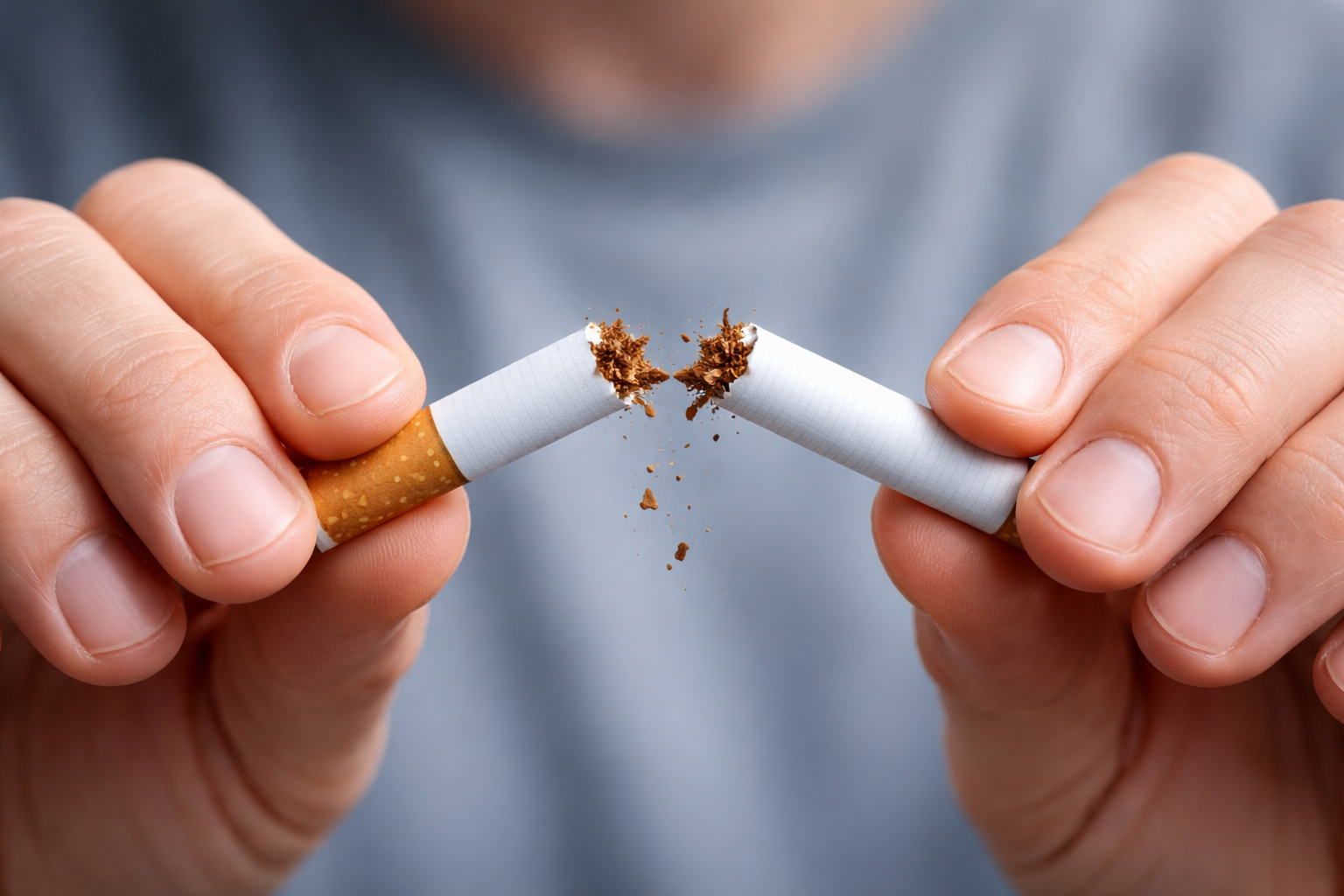

If you are looking for an effective nicotine-free treatment to help you quit smoking, you may have heard about cytisine. Although it has only recently been recognized in countries such as the United Kingdom and North America, this plant-derived substance has been used successfully for decades by millions of people in Central and Eastern Europe, making it one of the oldest and most reliable ways to quit smoking. It was recently added to WHO’s list of essenial medicines.
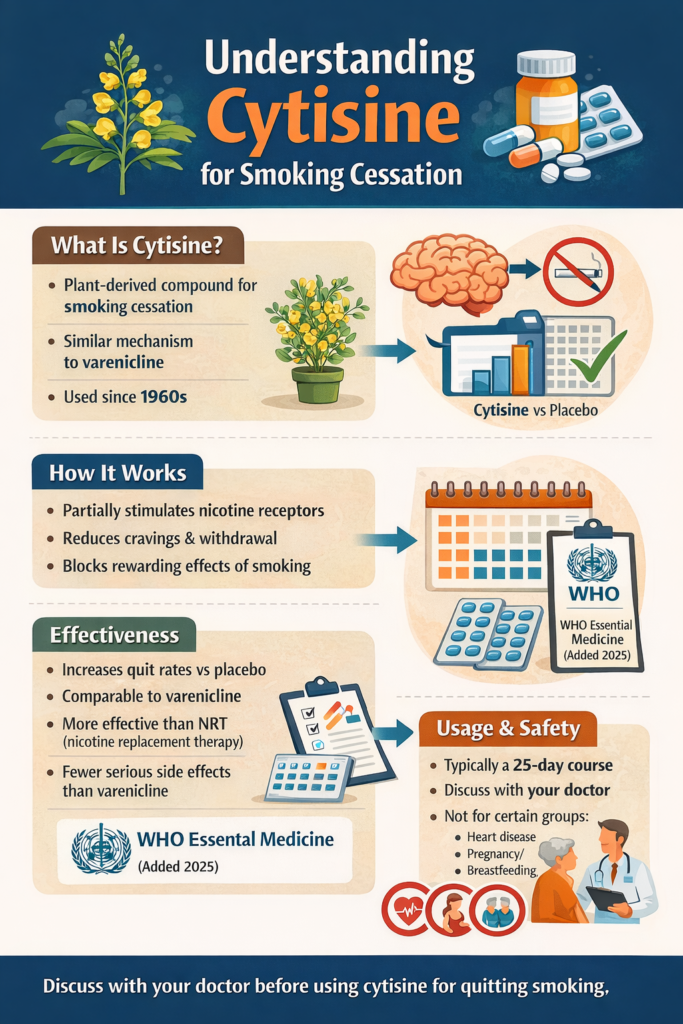
What Is Cytisine?
Cytisine is a naturally occurring plant alkaloid, a chemical substance extracted primarily from the seeds of plants in the Cytisus and Laburnum genera (like the Golden Rain acacia, which gets its name from its beautiful yellow flowers). It is referred to by its generic names cytisine or cytisinicline.
Like nicotine, cytisine is a natural insecticide, it kills insects by acting on their nervous system, and it also acts on the human nervous system. Its mechanism of action is similar to that of the prescription medication varenicline (Chantix/Champix). Cytisine works by acting as a partial agonist at the nicotinic acetylcholine receptors in the brain, the same receptors that nicotine targets.
Its action serves two critical purposes: it reduces nicotine cravings and withdrawal symptoms by partially activating these receptors, and it blunts the rewarding effect of smoking by blocking nicotine from fully binding to nicotinic receptors. Essentially, it “tricks” your brain into feeling like you’ve had some nicotine, making the experience of smoking less satisfying.
A Long History of Use
Cytisine is not a new discovery. It was first isolated in 1865, and during World War II, it was smoked by German and Russian soldiers as an accessible, cheap substitute for tobacco. However, its formal use as a pharmaceutical smoking cessation aid began in 1964, when the Bulgarian company Sopharma first marketed it under the brand name Tabex. Since the 1970s, it has been widely available and highly popular across many Central and Eastern European countries. Its extensive and long-term use has provided substantial data on its safety and effectiveness.
How Effective Is Cytisine?
The evidence supporting cytisine’s efficacy is strong and growing. Rigorous modern studies and meta-analyses have consistently demonstrated that smokers who use cytisine are about 1.3 times to 1.75 times more likely to achieve long-term abstinence compared to those using a placebo. Even with its short treatment course, cytisine has been found to be as effective as varenicline, and more effective than NRT (nicotine replacement therapy). Also, cytisine leads to a lower number of people reporting serious adverse effects compared to varenicline.
Given its efficacy and low cost, cytisine is often cited by public health experts as a medicine with the potential to have a major global impact on smoking rates. Cytisine was recently (2025) added to the World Health Organization (WHO) list of essential medicines, which could facilitate its adoption in more countries.
Side Effects and Withdrawal
The most commonly reported side effects of cytisine are mild to moderate and tend to occur mainly at the beginning of the treatment course before resolving. These may include gastrointestinal issues such as nausea, vomiting, dry mouth, or constipation, as well as sleep disturbances (insomnia or drowsiness), headache, dizziness, increased appetite, and irritability.
It is important to remember that many of these symptoms, such as irritability, sleep problems, increased appetite and mood changes, are also classical symptoms of nicotine withdrawal. It is important to distinguish between the two.
Dosage and Treatment Duration
Cytisine is typically taken as a 1.5 mg tablet or capsule and is prescribed as a 25-day course of treatment with a gradually reducing dose.
The treatment schedule is as follows:
- Days 1–3: One tablet every 2 hours (Maximum 6 tablets per day)
- Days 4–12: One tablet every 2.5 hours (Maximum 5 tablets per day)
- Days 13–16: One tablet every 3 hours (Maximum 4 tablets per day)
- Days 17–20: One tablet every 5 hours (Maximum 3 tablets per day)
- Days 21–25: One to two tablets per day (Maximum 2 tablets per day)
You must stop smoking no later than the fifth day of treatment. Although the standard course is 25 days, some clinical evidence suggests that a longer treatment, up to 12 weeks, may be more effective, but this is not the typical licensed duration.
Contraindications
Cytisine is generally not recommended and is contraindicated (should not be used) if you have:
- A known hypersensitivity (allergy) to cytisine or to any of the excipients in the product.
- Unstable angina, a recent history of heart attack, or clinically significant heart rhythm issues.
- A history of recent stroke.
- Are pregnant or breastfeeding.
It is also generally not recommended for people under 18 or over 65, or those with severe kidney or liver impairment, due to limited clinical data in these groups. Use with caution is advised for individuals with ischemic heart disease, heart failure, high blood pressure, ulcers, and certain other chronic conditions.
Main Brands
Cytisine is authorized for smoking cessation in 34 countries, and is included in the WHO’s list of essential medicines. It is manufactured and distributed by relatively small pharmaceutical companies rather than by “big pharma”:
- It is sold under the brand name Tabex since the 1960s (manufacturer: Sopharma in Bulgaria),
- and more recently Desmoxan (manufacturer: Aflofarm in Poland), and the same product by Aflofarm is sold under different brand names in different countries:
– Defumoxan in Romania,
– Liberisan in Hungary,
– Tadocitan in Spain,
– Asmoken in Austria and Germany,
– Decigatan in Belgium and the Netherlands,
– Dextazin in Portugal, and
– generic Cytisine in the UK. - Other brands include Cravv in Canada by Zpharm,
- and Tactizen in the UK.
- In France, the product Liberostin obtained the AMM approval, but the product is not yet on the market.
- The Polish firm Adamed Pharma produces cytisine tablets under the brand names Recigar (sold in also in Russia and Ukraine), and Cytisinicline Adamed, Glavrinxa and Belnifrem in the UK, distributed by Viatris.
- In Thailand, the Government Pharmaceutical Organization produces tablets under the brand name Cytisine GPO.
- In Australia, Quit4Good sells cytisine tablets that dissolve under the tongue, Nicoiq sells oral strips, and QSN sells cytisine tablets under the name NaturQuit.
- In the USA, the company Achieve Life Sciences conducted several randomized trials with the objective of obtaining FDA approval for its cytisinicline product.
- In some other countries, cytisine is not available as a commercial product, but is available as a compounded magistral preparation dispensed by pharmacists on medical prescription.
- There are probably other brands and manufacturers, so please tell us if you know of any, using the “Comments” field below.
Prescription only :
Only use cytisine if prescribed by a doctor; do not purchase it online without a prescription.
If you buy it online, be sure to purchase it directly from one of the manufacturers listed above to avoid buying counterfeit products.
If you have ever used cytisine, please feel free to share your experience in the “Comments” section below.
The Stop2smoke website provides information on other smoking cessation medications, such as varenicline or Nicotine Replacement Therapy (NRT)
References:
Read an comprehensive summary on cytisine here: Robert West, Magdalena Cedzyńska and Andy McEwen. Cytisinicline. Editor: Andy McEwen. 2026 National Centre for Smoking Cessation and Training (NCSCT). Version 2. Date of last modification: March 2026. ISBN 978-1-915481-01-6. https://www.ncsct.co.uk/library/view/pdf/Cytisine.pdf
Cytisine. By Robert West, Magdalena Cedzyńska and Andy McEwen, with contributions from Julia Robson, Lou Ross. Editor: Andy McEwen. UK National Centre for Smoking Cessation and Training (NCSCT): March 2025 (PDF).
Etter JF. Cytisine for smoking cessation: a literature review and a meta-analysis. Arch Intern Med. 2006 Aug 14-28;166(15):1553-9. doi: 10.1001/archinte.166.15.1553. PMID: 16908787.
Etter JF, Lukas RJ, Benowitz NL, West R, Dresler CM. Cytisine for smoking cessation: a research agenda. Drug Alcohol Depend. 2008 Jan 1;92(1-3):3-8. doi: 10.1016/j.drugalcdep.2007.06.017. Epub 2007 Sep 6. PMID: 17825502.
Livingstone-Banks J, Fanshawe TR, Thomas KH, Theodoulou A, Hajizadeh A, Hartman L, Lindson N. Nicotine receptor partial agonists for smoking cessation. Cochrane Database of Systematic Reviews 2023, Issue 6. Art. No.: CD006103. DOI: 10.1002/14651858.CD006103.pub9. Accessed 14 December 2025.
Tutka, P., Vinnikov, D., Courtney, R. J., and Benowitz, N. L. (2019) Cytisine for nicotine addiction treatment: a review of pharmacology, therapeutics and an update of clinical trial evidence for smoking cessation. Addiction, 114: 1951–1969. https://doi.org/10.1111/add.14721.
Walker N et al. Cytisine versus nicotine for smoking cessation. New England Journal of Medicine. 2014; 371(25): 2353–2362
Walker N, Bullen C, Barnes J, McRobbie H, Tutka P, Raw M, Etter JF, Siddiqi K, Courtney RJ, Castaldelli-Maia JM, Selby P, Sheridan J, Rigotti NA. Getting cytisine licensed for use world-wide: a call to action. Addiction. 2016 Nov;111(11):1895-1898. https://doi.org/10.1111/add.13464. Epub 2016 Jul 17. PMID: 27426482.
WHO. The selection and use of essential medicines, 2025: report of the 25th WHO Expert Committee on Selection and Use
of Essential Medicines, executive summary. Geneva: World Health Organization; 2025. https://doi.org/10.2471/B09544. Licence: CC BY-NC-SA 3.0 IGO.
WHO. 25th WHO Expert Committee on Selection and Use of Essential Medicines. Expert review. A.8 Cytisine – EML (Link)
Please use the ‘Comments’ field below to share your experience and to suggest improvments to this article.
Please rate this article by clicking on the desired number of stars: