

Help to stop smoking

Tag: arousal

  • Smoking and Female Sexual Function

    Smoking and Female Sexual Function

    Smoking also affects sexual function. For women, smoking may affect sexual desire, arousal, vaginal lubrication and the ability to reach orgasm. These effects are not always recognised, yet they can have a significant impact on intimate relationships and quality of life.

    How does smoking affect female sexual function?

    Sexual arousal depends partly on good blood circulation. When a woman becomes sexually aroused, blood flow to the clitoris and surrounding genital tissues increases. This contributes to genital sensitivity, swelling and vaginal lubrication.

    Nicotine causes blood vessels to narrow, while the many toxic substances in cigarette smoke damage the blood vessels and interfere with normal circulation. Smoking may therefore reduce blood flow to the genital area, making physical arousal more difficult.

    Some women who smoke experience reduced genital sensitivity, difficulties becoming aroused or insufficient vaginal lubrication. This can make sexual intercourse uncomfortable and less enjoyable.

    Smoking may also affect sexual desire. Although the relationship between smoking and libido is complex, nicotine dependence, changes in mood, hormonal effects and smoking-related health problems may all contribute to a reduced interest in sex.

    Orgasm can also be affected. Because sexual response depends on the interaction between blood circulation, nerve function and genital sensitivity, smoking may make it more difficult for some women to reach orgasm or experience the same level of sexual pleasure.

    Not every woman who smokes will experience these problems, and sexual difficulties can have many other causes.

    What does scientific research show?

    Studies have found an association between smoking and female sexual dysfunction. A systematic review and meta-analysis published in 2022, involving more than 15,000 women, found that female smokers had approximately 48% higher odds of sexual dysfunction than non-smokers.

    Other research has suggested that the risk may increase with the amount and duration of smoking.

    Although these findings do not prove that smoking is directly responsible for every sexual difficulty, they provide further evidence that tobacco use can affect women’s sexual health.

    Can quitting smoking improve female sexual function?

    Quitting smoking may help improve sexual function by allowing blood circulation and cardiovascular health to recover.

    Encouragingly, a prospective study examined sexual function in premenopausal women who stopped smoking. After nine months of smoking cessation, the researchers found significant improvements in sexual function: the proportion of women classified as having sexual dysfunction fell from 86% to 35%.

    Improvements are not guaranteed, however. Sexual function is influenced by many factors, including age, hormonal changes, menopause, stress, relationship difficulties and certain medications. Some women may notice changes after quitting, while others may not experience a significant difference.

    Smoking, hormones, menopause and fertility

    Smoking can also affect female reproductive health. Research suggests that women who smoke tend to reach menopause earlier than non-smokers, sometimes by several years.

    Smoking is also associated with reduced fertility and other reproductive health problems. Stopping smoking is therefore particularly important for women who are planning a pregnancy or wish to protect their long-term reproductive health.

    This matters because declining oestrogen levels during menopause can lead to vaginal dryness, reduced vaginal elasticity and discomfort during sexual intercourse. These changes may affect sexual desire and satisfaction.

    Speak to your doctor

    If you continue to experience vaginal dryness, pain during sex, reduced sexual desire or difficulties with arousal or orgasm, speak to a healthcare professional. These problems are common and often treatable.


    Please use the Comments field below to share your experience or to suggest improvements to this article.


    Rate this article by clicking on the desired number of stars:
    (No Ratings Yet)


    References

    1. Salari N, Hasheminezhad R, Abdolmaleki A, Kiaei A, Shohaimi S, Akbari H, Nankali A, Mohammadi M. The effects of smoking on female sexual dysfunction: a systematic review and meta-analysis. Arch Womens Ment Health. 2022 Dec;25(6):1021-1027. https://doi.org/10.1007/s00737-022-01281-1.
    2. Harte CB, Meston CM. The inhibitory effects of nicotine on physiological sexual arousal in nonsmoking women: results from a randomized, double-blind, placebo-controlled, cross-over trial. J Sex Med. 2008 May;5(5):1184-1197. https://doi.org/10.1111/j.1743-6109.2008.00778.x
    3. Celikhisar H, Dasdemir Ilkhan G, Irer B. Effects of smoking cessation on sexual functions and health quality of life in premenopausal women: A prospective case – Controlled study. Int J Clin Pract. 2021 Mar;75(3):e13796. https://doi.org/10.1111/ijcp.13796
    4. Soheila Nazarpour, Masoumeh Simbar, Fahimeh Ramezani Tehrani, Factors affecting sexual function in menopause: A review article, Taiwanese Journal of Obstetrics and Gynecology, Volume 55, Issue 4, 2016, Pages 480-487, ISSN 1028-4559, https://doi.org/10.1016/j.tjog.2016.06.001.
    5. Raphael C. Parente, Eduardo Faerstein, Roger Keller Celeste, Guilherme L. Werneck,
    6. Raphael C. Parente, Eduardo Faerstein, Roger Keller Celeste, Guilherme L. Werneck, The relationship between smoking and age at the menopause: A systematic review, Maturitas, Volume 61, Issue 4, 2008, Pages 287-298, ISSN 0378-5122, https://doi.org/10.1016/j.maturitas.2008.09.021.

  • Sexuality and smoking

    Sexuality and smoking

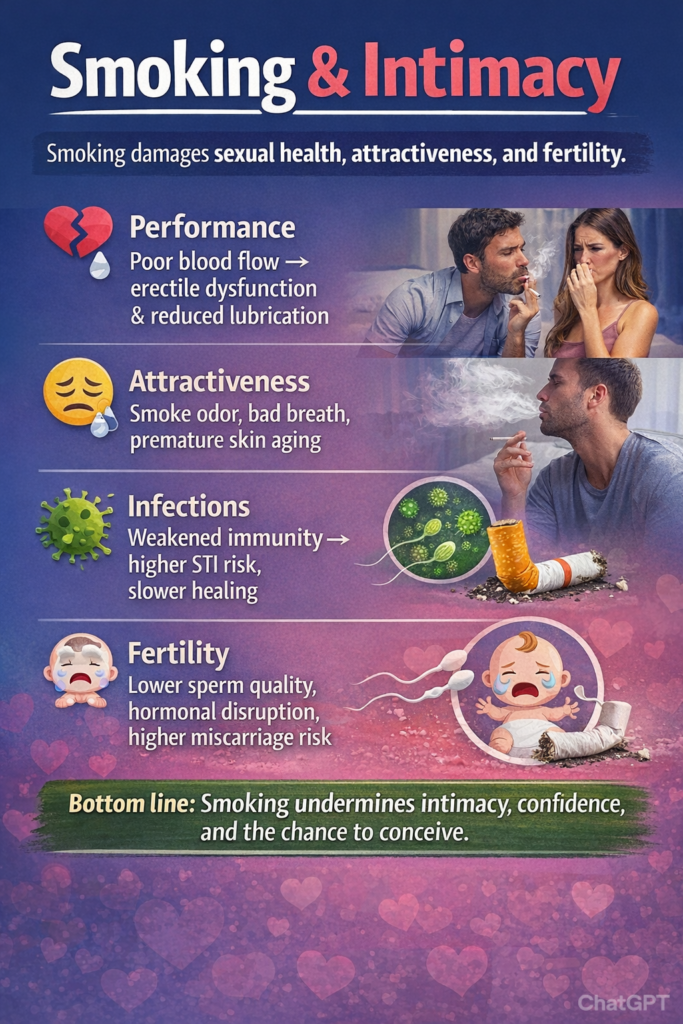
    Smoking affects your sex life, your ability to have children and your intimate health. The encouraging part is that many of these effects improve after you quit, often sooner than people expect.

    By Jean-François Etter, professor of public health.

    Why smoking affects sexual arousal

    Sexual arousal depends on healthy blood flow. Cigarette smoke contains thousands of chemicals that injure the lining of blood vessels, make them narrower and stiffer, and over time contribute to atherosclerosis (hardening and blockage of the arteries). Nicotine also causes blood vessels to constrict with every cigarette.

    For men, an erection requires a rapid increase in blood flow. Studies consistently find that smokers are around 1.5 times more likely to develop erectile dysfunction (ED) than non-smokers, and the risk rises with the number of cigarettes smoked and the number of years of smoking. ED in smokers also tends to appear at a younger age.

    A warning : because the arteries supplying the penis are small, ED can be one of the first signs of wider blood-vessel disease. If you smoke and notice erection problems, see a doctor. It may be an early signal about your heart health, and it is a good reason to quit.

    For women, reduced blood flow to the genital area can mean weaker arousal, less natural lubrication and more difficulty reaching orgasm. This can make sex less enjoyable or uncomfortable. Research in this area is less extensive than for ED, but the underlying mechanism is the same, and the size of the effect is also the same : the risk of female sexual dysfunction is increased 1.5 times in smokers.

    Smoking and your intimate health

    Smoking weakens several of the body’s defences. One well-established example is HPV, the virus behind most cervical cancers. Smokers are more likely to be infected than non-smokers, and smokers who are infected are more likely to have the infection persist and to develop precancerous changes in the cervix and carcinoma of the cervix. Smoking is also a risk factor for bacterial vaginosis.Smoking can also slow healing, which may matter after infections or surgical procedures.
    HPV vaccination, regular screening and quitting smoking together offer the best protection.

    Smoking and fertility

    Smoking can make it harder to conceive, for men and women alike.

    • Sperm: Smoking is linked to lower sperm concentration, poorer movement (motility) and more abnormally shaped sperm, reducing the chances of fertilisation.
    • Eggs and hormones: In women, smoking can disrupt the menstrual cycle, damage eggs and bring on menopause one to four years earlier on average.
    • Conception and pregnancy: Smokers generally take longer to conceive and have a higher risk of miscarriage and ectopic pregnancy. See our article on smoking and pregnancy for more.
    • Fertility treatment: Smoking lowers the success rates of IVF and other assisted reproduction.
    • Secondhand smoke: A non-smoking partner exposed to smoke is also affected, and exposure during pregnancy harms the baby.

    If you use hormonal contraception, note that combining it with smoking carries specific risks, especially blood clots. Read more about smoking and the contraceptive pill.

    Other effects on intimacy

    Smoking can reduce stamina and cause breathlessness, which affects physical activity of every kind. The smell of smoke on breath, hair and clothes, along with skin ageing and stained teeth, can also affect how comfortable people feel about their bodies and closeness with others. These effects vary from person to person, and many people notice them more in themselves than their partners do.

    What happens when you quit?

    The body begins to repair itself sooner than most people think.

    • Within weeks: circulation starts to improve and breathing becomes easier.
    • Within about three months: sperm quality can begin to recover.
    • Within months: many former smokers, especially younger men and those with milder problems, notice improvement in erectile function.
    • Over the longer term: fertility, pregnancy outcomes and cardiovascular risk improve, with the benefits growing the longer you stay smoke-free.

    Recovery is not guaranteed for everyone, particularly after many years of smoking, but quitting offers the best chance of improvement. It also helps any other treatment work better.

    The next steps

    • Speak with a doctor about any sexual or fertility concerns. Several causes are possible, and effective treatments exist.
    • If you are trying to conceive, quitting smoking now, for both partners, improves your chances.
    • Support makes quitting much more likely to succeed. Nicotine replacement therapy and prescription medications can double your chances compared with going it alone, and your doctor or pharmacist can support you and help you choose the best treatment. Or you can call a helpline.

    Please use the Comments field below to share your experience or to suggest improvements to this article.


    Rate this article by clicking on the desired number of stars:
    (No Ratings Yet)


    References:

    Salari, N., Hasheminezhad, R., Abdolmaleki, A. et al. The effects of smoking on female sexual dysfunction: a systematic review and meta-analysis. Arch Womens Ment Health 25, 1021–1027 (2022). https://doi.org/10.1007/s00737-022-01281-1

    Mark S. Allen, Emma E. Walter, Health-Related Lifestyle Factors and Sexual Dysfunction: A Meta-Analysis of Population-Based Research, The Journal of Sexual Medicine, Volume 15, Issue 4, April 2018, Pages 458–475, https://doi.org/10.1016/j.jsxm.2018.02.008

    Kovac, J. R., Khanna, A., & Lipshultz, L. I. (2015). The effects of cigarette smoking on male fertility. Postgraduate Medicine, 127(3), 338–341. https://doi.org/10.1080/00325481.2015.1015928

    Alan Penzias, et al., Smoking and infertility: a committee opinion, Fertility and Sterility, Volume 110, Issue 4, 2018, Pages 611-618, ISSN 0015-0282, https://doi.org/10.1016/j.fertnstert.2018.06.016.

    Smart S, Singal A, Mindel A. Social and sexual risk factors for bacterial vaginosis. Sexually Transmitted Infections 2004;80:58-62. https://doi.org/10.1136/sti.2003.004978

    Cao S, Yin X, Wang Y, Zhou H, Song F, et al. (2013) Smoking and Risk of Erectile Dysfunction: Systematic Review of Observational Studies with Meta-Analysis. PLOS ONE 8(4): e60443. https://doi.org/10.1371/journal.pone.0060443

    Salari, N., Hasheminezhad, R., Abdolmaleki, A. et al. The effects of smoking on female sexual dysfunction: a systematic review and meta-analysis. Arch Womens Ment Health 25, 1021–1027 (2022). https://doi.org/10.1007/s00737-022-01281-1

    Salvatore Vaccarella, Rolando Herrero, Peter J F Snijders, Min Dai, Jaiye O Thomas, Nguyen Trong Hieu, Catterina Ferreccio, Elena Matos, Hector Posso, Silvia de Sanjosé, Hai Rim Shin, Sukhon Sukvirach, Eduardo Lazcano-Ponce, Nubia Muñoz, Chris J L M Meijer, Silvia Franceschi, the IARC HPV Prevalence Surveys (IHPS) Study Group, Smoking and human papillomavirus infection: pooled analysis of the International Agency for Research on Cancer HPV Prevalence Surveys, International Journal of Epidemiology, Volume 37, Issue 3, June 2008, Pages 536–546, https://doi.org/10.1093/ije/dyn033

    Mzarico E, Gómez-Roig MD, Guirado L, Lorente N, Gonzalez-Bosquet E. Relationship between smoking, HPV infection, and risk of Cervical cancer. Eur J Gynaecol Oncol. 2015;36(6):677-80. PMID: 26775350.

    Kovac JR, Khanna A, Lipshultz LI. The effects of cigarette smoking on male fertility. Postgrad Med. 2015 Apr;127(3):338-41. Epub 2015 Feb 19. https://doi.org/10.1080/00325481.2015.1015928.

    Harte, C.B. and Meston, C.M. (2012), Association between smoking cessation and sexual health in men. BJU International, 109: 888-896. https://doi.org/10.1111/j.1464-410X.2011.10503.x

    A.L. Waylen, M. Metwally, G.L. Jones, A.J. Wilkinson, W.L. Ledger, Effects of cigarette smoking upon clinical outcomes of assisted reproduction: a meta-analysis, Human Reproduction Update, Volume 15, Issue 1, January-February 2009, Pages 31–44, https://doi.org/10.1093/humupd/dmn046

    Sven Cnattingius, The epidemiology of smoking during pregnancy: Smoking prevalence, maternal characteristics, and pregnancy outcomes, Nicotine & Tobacco Research, Volume 6, Issue Suppl_2, April 2004, Pages S125–S140, https://doi.org/10.1080/14622200410001669187