
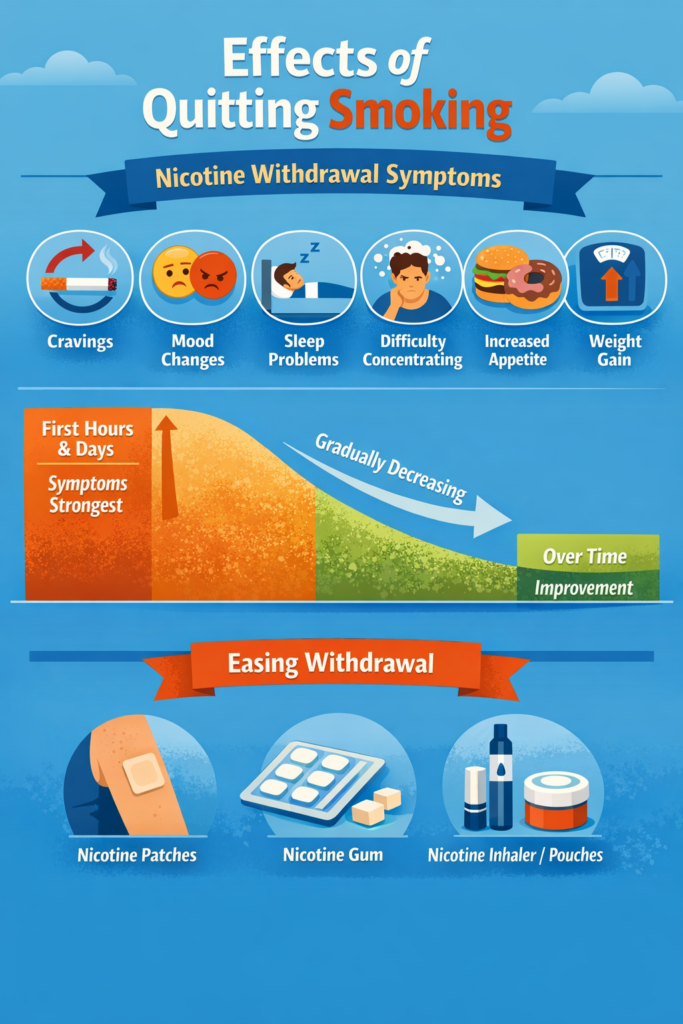
Quitting smoking causes nicotine withdrawal: cravings, mood changes (irritability, sadness, anxiety), sleep problems, difficulty concentrating, increased appetite and weight gain. Withdrawal symptoms can be eased with nicotine replacement therapies or other non-combustible nicotine sources (Video▶️).
What happens when you stop smoking?
When you stop smoking, your body no longer gets its dose of nicotine, and it’s normal to feel uncomfortable. Here are the withdrawal symptoms you may experience:
- A very strong urge to smoke (craving)
- Being in a bad mood :
– sad or depressed,
– angry, irritated,
– impatient or agitated. - Anxious or nervous, rapid mood swings.
- Poor sleep (insomnia).
- Difficulty concentrating.
- Increased hunger and weight gain.
- But quitting smoking also brings about a rapid improvement in smell and taste.
How long do these symptoms last?
These symptoms are most intense during the first few hours and days after your last cigarette. After the first few days, these feelings diminish significantly, but be aware that some symptoms may last longer:
– The urge to smoke may return at times for several months. This is normal, but it will pass.
– Some people feel sad or depressed for a long time. Talk to your doctor if this is the case for you.
– Weight gain may be permanent.
What can you do ?
To attenuate these withdrawal symptoms, you can use nicotine medications (patch, gum, tablet, inhaler). You can also use another nicotine source that does not burn tobacco, such as an electronic cigarette or a nicotine pouch. Cravings last just a few minutes, so just wait 5 minutes and it will pass
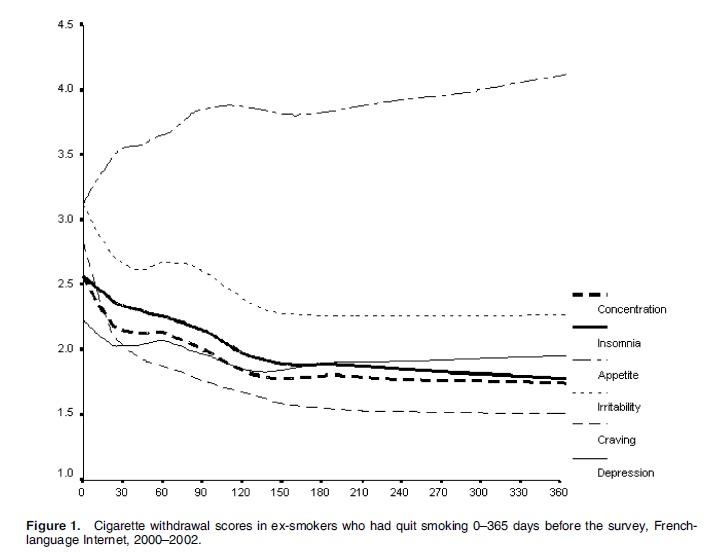
Change in symptom intensity over the course of a year
The graph below, taken from one of our scientific publications, shows how the intensity of withdrawal symptoms changes during the first year after quitting smoking.
– The most striking feature is that appetite and weight gain increase, while the intensity of all other symptoms decreases over time.
– The symptom that decreases most rapidly in intensity is craving, i.e. the strong urge to smoke.
– The intensity of all symptoms changes most rapidly during the first 30 days after quitting smoking.
– After about 6 months, symptoms remain stable.
References:
Jean-François Etter, A Self-Administered Questionnaire to Measure Cigarette Withdrawal Symptoms: The Cigarette Withdrawal Scale, Nicotine & Tobacco Research, Volume 7, Issue 1, February 2005, Pages 47–57, https://doi.org/10.1080/14622200412331328501
Etter JF, Hughes J. A comparison of the psychometric properties of three cigarette withdrawal scales. Addiction, 2006,101,262-372.
Please rate this article by clicking on the desired number of stars:
Please use the “Comments” field below to share your experience or suggest improvements to this article.




Leave a Reply