

Measuring your waist circumference provides a quick and easy assessment of your abdominal fat, which is a good indicator of your risk of developing health problems such as diabetes, cardiovascular disease and high blood pressure. Here is how to measure your waist circumference and interpret the result:
Check your measurement and your health risk:
Body fat is distributed in two ways: under the skin and in the abdomen. It is mainly abdominal fat that is associated with a higher risk of disease and mortality. Measuring your waist circumference provides a simple, inexpensive, and reliable estimate of your amount of abdominal fat.
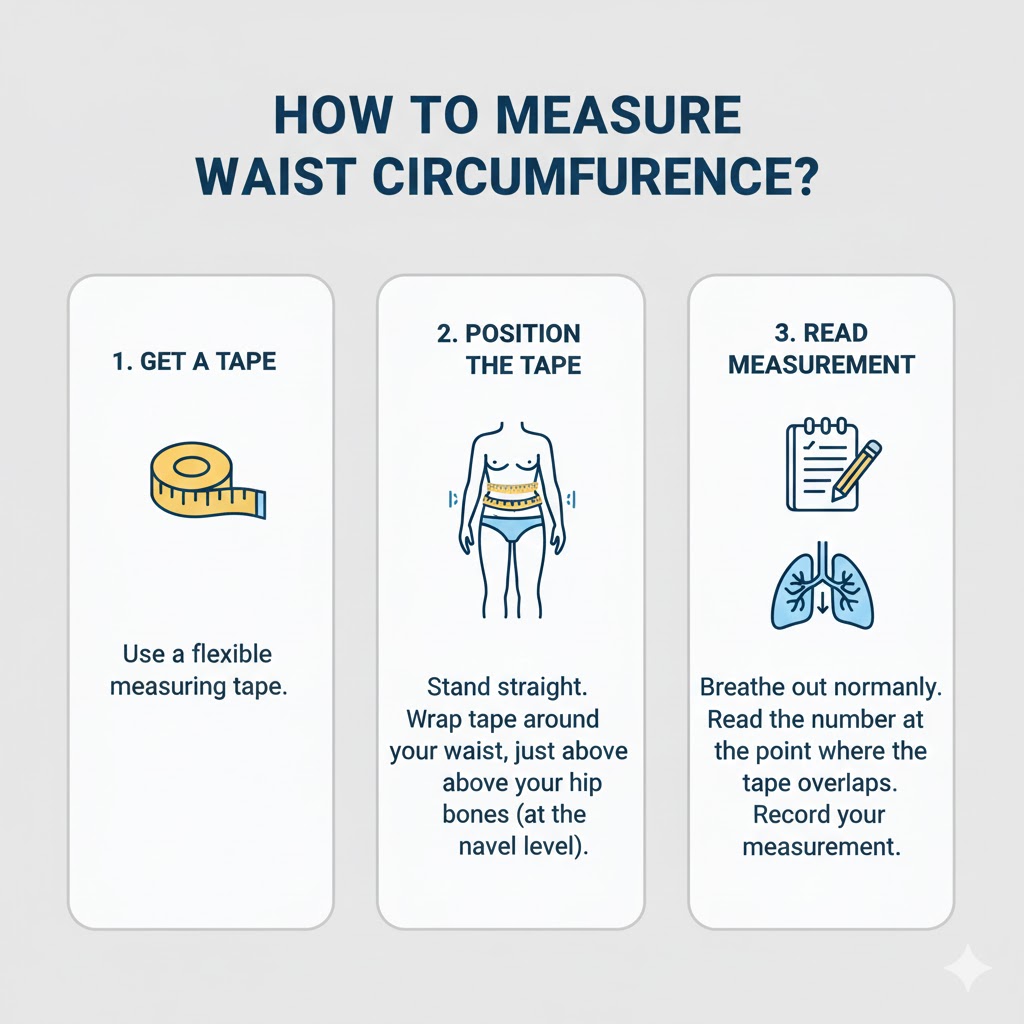
Here’s how to measure your waist circumference:
- Get a flexible measuring tape (sewing tape measure), then locate the top of your iliac crest (the protruding bone on the side where your belt rests) on each side.
- Stand up straight with your heels and toes touching the floor and breathe normally.
- Wrap the tape around your waist, at the level of your two iliac crests and your navel, directly on the skin.
- Make sure the tape is snug, not too tight, and that it forms a ring parallel to the floor.
- Take the measurement after exhaling (= emptying your lungs). Write down the measurement and the date.
Here is how to interpret the measurement result:
Based on guidelines from organizations such as the World Health Organization (WHO) and various health agencies, here are the generally accepted thresholds for high risks and very high risks associated with waist circumference in adults:
Waist circumference risk thresholds (PDF):
| Sex | Risk Level | Waist: cm | Waist: Inches |
| Women | High Risk | ≥ 80 cm | ≥ 31.5 in |
| Very High Risk | ≥ 88 cm | ≥ 35 in | |
| Men | High Risk | ≥ 94 cm | ≥ 37 in |
| Very High Risk | ≥ 102 cm | ≥ 40 in |
Waist size and health consequences:
If your waist circumference is greater than 94 cm / 37 in (men) or 80 cm / 31.5 in (women), this may indicate that you have excess abdominal fat. In this case, a change in lifestyle is recommended (eating better and exercising more), or medical treatment for overweight or obesity may be warranted.(a) Note that even if your body mass index (BMI) is within the normal range (below 25 kg/m²), your cardiovascular risk is increased if your waist circumference exceeds the above values.
A waist circumference greater than 102 cm / 40 in for men and 88 cm / 35 in for women is one of the diagnostic criteria for metabolic syndrome. This syndrome includes several factors associated with an increased risk of cardiovascular disease, including: high blood cholesterol, sugar, and insulin levels, high blood pressure, inflammation, etc.
A large waist circumference is also strongly associated with the risk of developing type 2 diabetes, even more so than body mass index (BMI).(a) A large waist circumference is also strongly associated with the risk of cardiovascular mortality, as well as the risk of death from all causes.(a)
How to lose weight?
By reducing your waist circumference, you increase your chances of avoiding diabetes, cardiovascular disease, or premature death.
– Follow our advice for losing weight,
– Consult a professional who may be able to prescribe treatment,
– Get support.
Please note:
It is strongly discouraged to lose weight if you are underweight, i.e., if, as an adult, your BMI is less than 18.5 kg/m2.
Please rate this article by clicking on the desired number of stars: (1 votes, average: 5.00 out of 5)
 Loading...
=> Also calculate your body mass index (BMI).
Use the Comment field below to share your experience and suggest improvements to this article.
Or write a testimonial about it.
If you like this article, please share it on social media or on your website.
Reference:
a) Ness-Abramof, R. and Apovian, C.M. (2008), Waist Circumference Measurement in Clinical Practice. Nutr Clin Pract, 23: 397-404. https://doi.org/10.1177/0884533608321700




Leave a Reply