
Category: Community

  • My spouse smokes

    My spouse smokes

    Living with someone who smokes can stir up a mix of emotions: worry for their health, frustration about the smell in the house, fear for your own well-being, and sometimes even resentment. These reactions are normal. Tobacco use affects not only the person who smokes but also the couple’s daily life, routines, intimacy, and sense of security about the future. The challenge is to address the issue without letting it erode the relationship.

    Understanding before reacting

    Smoking is not simply a habit that can be switched off at will. Nicotine dependence is powerful, both physically and psychologically. For many people, cigarettes are tied to stress relief, social moments, or personal identity. When a partner demands that the other “just stop,” it can feel like an attack rather than support.
    Taking time to understand what smoking represents for your spouse — relaxation, a break, a coping mechanism — changes the tone of the conversation. Curiosity and empathy open doors that criticism closes.

    Communicating without blame

    Conversations about smoking often go wrong when they start with accusations or ultimatums. Words like “you’re selfish” or “you’re ruining your health” may be fueled by concern, but they trigger defensiveness. Speaking from your own experience is more constructive: explaining that you feel worried, that the smoke makes you uncomfortable, or that you fear for your future together.
    This approach shifts the focus from judging their behavior to sharing your feelings. It invites dialogue instead of conflict.

    Protecting your shared space

    It is reasonable to set boundaries that protect your health and comfort. Agreeing that smoking will take place outdoors, keeping certain rooms smoke-free, or improving ventilation are practical steps that reduce tension. When these boundaries are discussed calmly and mutually, they are more likely to be respected.
    The goal is not to control your spouse but to create a living environment that feels safe for both of you.

    Preserving closeness and intimacy

    Smoking can affect physical closeness — the smell of smoke, concerns about health, or reduced sexual comfort. Avoid letting these issues become silent barriers. Address them gently and honestly. Maintaining affection, shared activities, and moments of connection helps ensure that smoking does not become the defining feature of your relationship.
    Your partner is more than their dependence. Keeping that perspective protects the emotional bond you share.

    Supporting a decision to quit

    You cannot force someone to quit, but you can make quitting easier when they are ready. Encouragement works better than pressure. Recognize small steps, such as delaying the first cigarette of the day or considering alternatives. Offer practical help: researching cessation aids, accompanying them to a medical appointment, or simply being present during difficult moments.
    Relapses can happen. Responding with patience rather than disappointment makes it more likely that your spouse will try again.

    Adopting a sustainable attitude

    Living with a smoker requires balance. Constant monitoring or repeated reminders rarely help and often create distance. At the same time, ignoring the issue entirely can breed silent resentment. A constructive attitude lies somewhere in between: clear about your needs, compassionate about their struggle, and realistic about the time change may take.
    Taking care of your own well-being is part of this balance. Seeking support, staying informed, and maintaining your own routines help you remain steady and supportive.

    Looking toward the future together

    Many couples navigate this challenge successfully. When smoking is approached as a shared concern rather than a personal failing, it can even strengthen communication and mutual understanding. Whether your spouse quits soon, later, or struggles along the way, what matters most is preserving respect, empathy, and the sense that you are on the same side.

    Your role is not to be a police officer or a savior. It is to be a partner — concerned, honest, and supportive — while protecting your own health and the relationship you both value.


    Use the ‘Comments’ field below to share your experience on this topic or to suggest improvements to this article.


  • My partner smokes

    My partner smokes

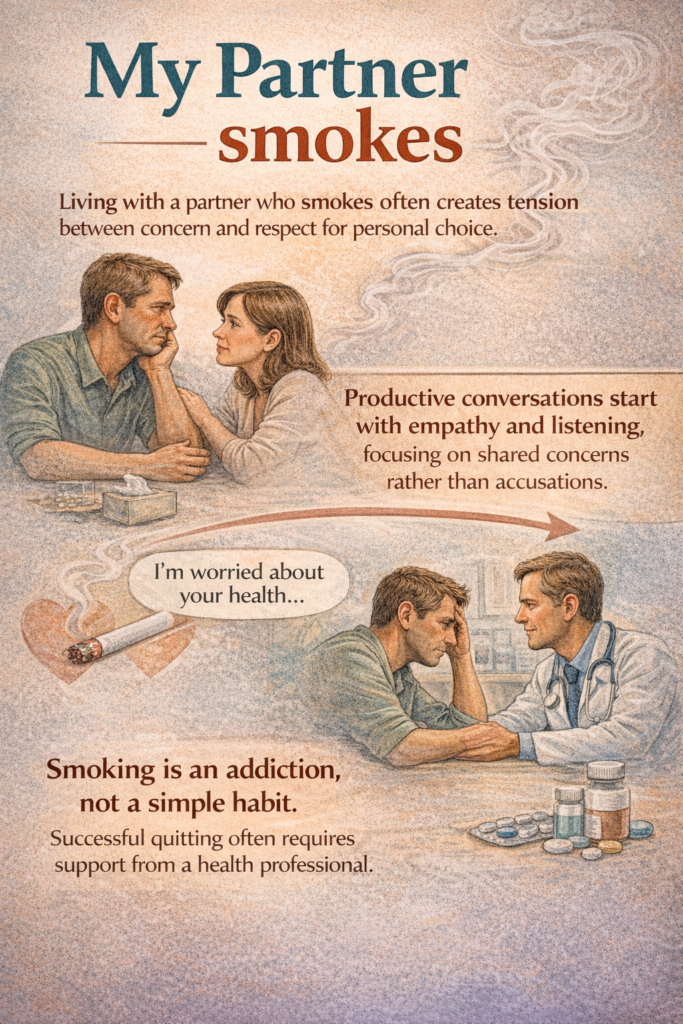
    Living with a partner who smokes often creates tension between concern and respect for personal choice. Pressuring or blaming rarely works, as smoking is tied to routine, identity, and dependence. Productive conversations start with empathy, good timing, and listening, focusing on shared concerns rather than accusations. Lasting change depends on the smoker’s own motivation, supported by patience and mutual understanding. Above all, smoking is an addiction, not a simple habit, and successful quitting often requires support from a health professional as well as encouragement from a partner.

    Living with someone who smokes can be complicated. It is rarely just about the smell of tobacco or the smoke lingering in the air. It often touches deeper concerns: health, shared space, future plans, and sometimes fear. Many people find themselves caught between the desire to protect their loved one and the risk of turning every conversation into a source of tension.

    Resistance to change is a natural human reaction, and smoking is no exception. For many smokers, cigarettes are tied to routine, stress relief, social moments, and identity. Asking someone to quit can feel, to them, like an attack on personal freedom or a denial of comfort in an already demanding world. This is why pressure, ultimatums, or repeated reproaches so often backfire. They may provoke defensiveness, silence, or even increased smoking.

    Starting a conversation requires timing and tone more than arguments. Choosing a calm moment, away from conflict, makes a difference. Speaking from personal feelings rather than accusations helps keep the discussion open. Saying “I’m worried about your health” or “I find it hard to live with smoke at home” invites dialogue, while blame tends to shut it down. Listening matters as much as speaking. Many smokers are already aware of the risks and feel trapped between guilt and dependence.

    Effective approaches are rarely dramatic. Small, realistic steps are often better accepted than grand demands. Agreeing on smoke-free spaces, acknowledging attempts to cut down, or simply recognizing how difficult quitting can be can shift the dynamic from confrontation to cooperation. Change is more likely when the smoker feels respected rather than judged.

    At the heart of lasting change is inner motivation. No one quits smoking successfully just to please someone else, at least not for long. The decision has to come from within. A partner can help by gently encouraging reflection: What does smoking bring? What does it take away? How might life look without it? These questions open doors without forcing answers.

    Mutual support plays a crucial role. Quitting smoking is not a solitary act; it affects daily routines, moods, and relationships. When partners face it together, the burden is lighter. Support may mean patience during irritability, celebrating progress rather than perfection, or adjusting shared habits that trigger smoking. It also means acknowledging that setbacks happen and do not equal failure.

    Perhaps the most important point is often overlooked: smoking is not just a habit, it is an addiction. Nicotine changes the brain, creates dependence, and makes quitting far more complex than simple willpower. Treating nicotine addiction as a medical issue rather than a moral weakness changes the conversation. Health professionals are trained to help, with counseling, medications, and strategies that significantly improve the chances of success.

    Loving someone who smokes can be frustrating, worrying, and at times exhausting. Yet approaching the issue with empathy, patience, and realism can transform conflict into collaboration. When smoking is understood as an addiction and quitting as a process that deserves support and professional care, the path forward becomes clearer, and more hopeful, for both partners.


    Use the ‘Comments’ field below to share your experience on this topic or to suggest improvements to this page.


  • 10 policies against smoking

    10 policies against smoking

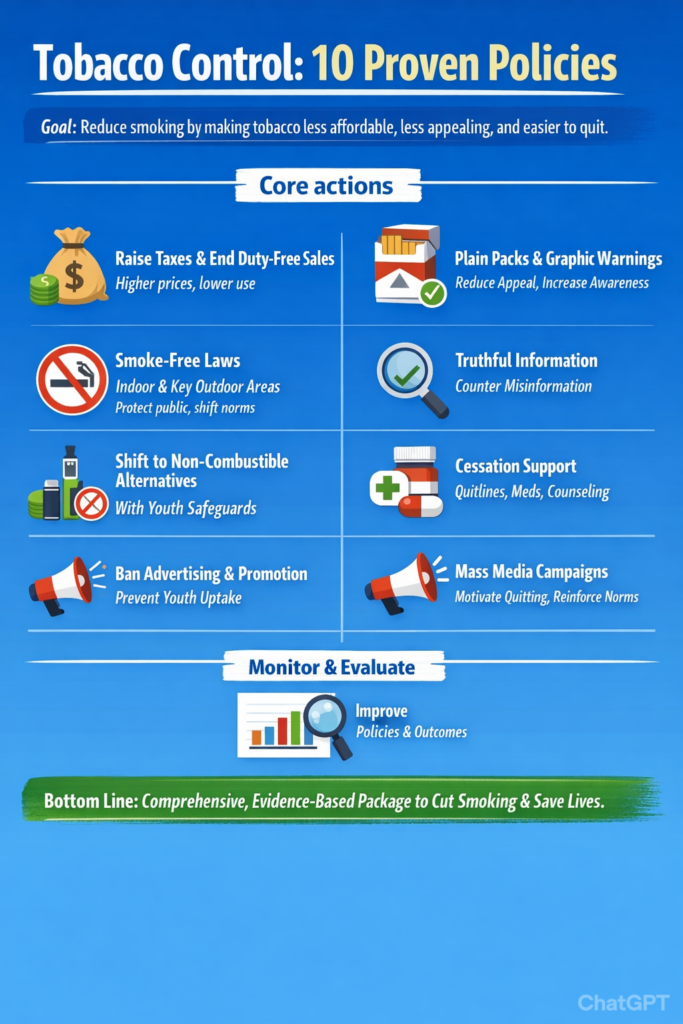
    Smoking remains a scourge on public health and a major factor of healthcare costs, but the good news is that governments worldwide have effective and proven tools at their disposal to combat it. This article presents the ten most effective policy measures, backed by scientific evidence, that can significantly reduce smoking and save lives.

    These policies work by either making smoking less appealing and accessible, or by empowering smokers to quit.


    The Economic Approach: Making Tobacco Unaffordable

    1. Raise Taxes on Tobacco Products

    This is widely considered the single most effective policy for reducing tobacco consumption. Significant and regular increases in excise taxes make tobacco products less affordable, discouraging young people from starting and incentivizing current users to quit. For every 10% price increase, studies show a significant reduction in overall consumption, with the greatest impact seen among youth and low-income populations.

    2. Eliminate Tax-Free and Duty-Free Sales

    By removing tax exemptions for tobacco sold at airports and border crossings, governments close a loophole that allows products to be sold at artificially low prices. This policy maintains the price disincentive and prevents cheap tobacco from undermining local taxation efforts.

    Clean Air and Social Norms: Protecting the Public

    3. Implement Comprehensive Smoke-Free Laws

    Laws mandating 100% smoke-free indoor public places, workplaces, restaurants, and bars protect non-smokers from the harms of secondhand smoke. Furthermore, these policies change social norms, making smoking less visible, less socially acceptable, and providing a powerful incentive for smokers to quit. Well-enforced bans have been shown to reduce smoking prevalence itself.

    Extending smoke-free regulations to include outdoor areas—such as parks, beaches, school grounds, and hospital entrances—further de-normalizes smoking, protects children from exposure, and reinforces the public health message that smoking is not a typical behaviour.

    Replace combustible products with smokefree products

    4. Accelerate the replacement of cigarettes with non-combustible products

    The tobacco market is undergoing rapid change, with cigarettes becoming an obsolete and inferior product, replaced by non-combustible alternatives.

    It is essential to accelerate the transition of smokers to these new products, while implementing effective and proportionate policies to prevent young non-smokers from starting to use nicotine or tobacco.

    5. Providing truthful information and combating disinformation

    Misinformation about harm reduction and non-combustible nicotine and tobacco products is ubiquitous. Governments should support the creation and dissemination of truthful, balanced, and honest information on these topics.

    Stopping the Next Generation: Eliminating Promotion and Appeal

    6. Enforce Comprehensive Bans on Tobacco Advertising, Promotion, and Sponsorship (TAPS)8

    Tobacco advertising recruits new users and undermines quit attempts. A total ban on all forms of TAPS—including in traditional media, online, at the point of sale, and through product placement or sponsorship—is highly effective at reducing tobacco initiation, particularly among youth.9

    7. Mandate Graphic Health Warnings and Plain Packaging

    Removing all branding, colours, and promotional elements from tobacco packaging (plain packaging) and requiring large, graphic health warnings that cover at least 50% (and ideally much more) of the pack surface reduces the product’s appeal and increases consumer awareness of the harms.10 This policy eliminates the pack as a marketing tool.11

    Empowerment and Support: Helping People Quit

    8. Provide Accessible and Affordable Smoking Cessation Services

    While policies reduce demand, many addicted smokers need help to quit.15 Governments must invest in comprehensive cessation support, including:

    • Toll-free national quitlines.
    • Coverage for proven therapies (like NRT and prescription medicines such as varenicline and cytisine) and behavioral counselling through national health insurance programs.16
    • Integrating ‘Ask, Advise, Refer’ protocols into routine healthcare.17

    9. Run Sustained, High-Impact Mass Media Campaigns

    Hard-hitting, professionally produced anti-tobacco media campaigns that clearly communicate the health risks and benefits of quitting are highly effective.18 These campaigns should be sustained over time and run at high frequency to ensure maximum reach and impact, reinforcing the message that help is available.

    Monitor tobacco use and evaluate interventions

    10. Monitor tobacco use and evaluate campaigns and policies

    It is crucial to monitor tobacco and nicotine use in each population subgroup, and to assess the intended and unintended effect of all interventions, campaigns, policies, treatments and other anti-tobacco measures.


    Use the ‘Comments’ field below to share your experience or to suggest improvements to this article.

  • Helplines

    Helplines

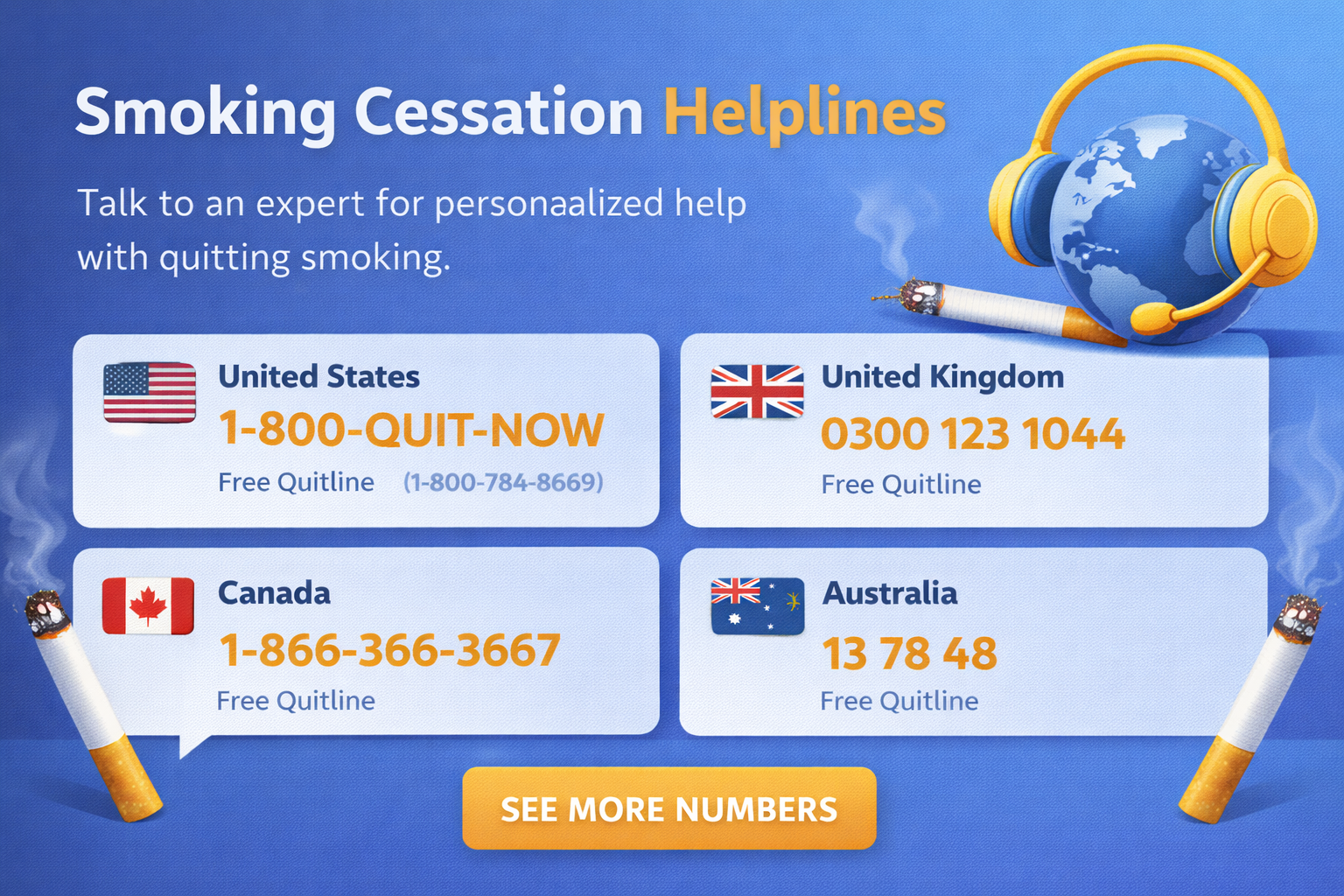
    Telephone helplines provide advice, help and support to quit smoking. Do not hesitate to call them. Here are the best and most widely recognized smoking cessation helplines, or “Quitlines,” for the US, UK, Canada, Australia and New Zealand. They offer free, evidence-based telephone counseling

    🇺🇸 United States

    • 1-800-QUIT-NOW (1-800-784-8669)
      • Provider: This is the national access number supported by the National Cancer Institute (NCI). When called, it automatically connects the caller to their state’s local quitline.
      • Service: Offers free, confidential phone counseling, help with building a quit plan, information on cessation medications, and referrals to local programs.
    • 1-877-44U-QUIT (1-877-448-7848)
      • Provider: National Cancer Institute (NCI).
      • Service: Specifically for smokers seeking NCI smoking cessation information and assistance.

    🇨🇦 Canada

    • 1-866-366-3667 (The Smokers’ Helpline)
      • Provider: Canadian Cancer Society (in partnership with provincial governments).
      • Service: Provides free, confidential telephone counseling and support in multiple languages. They also offer online support, text messaging programs, and community referrals across the country.

    🇬🇧 United Kingdom

    The UK operates through decentralized, local services, but provides central resources:

    • National NHS Smokefree Helpline: 0300 123 1044
      • Provider: National Health Service (NHS).
      • Service: Offers free advice, support, and encouragement from a trained specialist. The NHS also promotes local “Stop Smoking Services” which are often considered the most effective path, offering face-to-face support.

    🇦🇺 Australia

    • 13 7848 (13 QUIT) (Quitline)
      • Provider: National Quitline services, often managed by Cancer Councils in partnership with state/territory health departments.
      • Service: Provides free, confidential telephone support from trained counselors, personalized quitting strategies, and information on nicotine replacement therapy (NRT).

    🇳🇿 New Zealand

    • 0800 778 778 (Quitline)
      • Provider: Quitline New Zealand (Hāpainga).
      • Service: Offers free phone counseling, text support, and access to subsidized NRT (patches, gum, lozenges). They place a strong emphasis on providing culturally sensitive support, including to Māori communities.

  • Doctors and clinical services

    Doctors and clinical services

    Here is a list of smoking cessation clinics and programs:


    🇺🇸 United States


    🇬🇧 United Kingdom

    ✅ NHS Stop Smoking Services

    Other UK Resource

    • National Centre for Smoking Cessation and Training (NCSCT) – Provides training, resources, and links for evidence-based cessation support (useful for providers and pathways to services). NCSCT smoking cessation support📍

    🇦🇺 Australia

    📍 Government Support & Quitline

    • Australian Government Smoking & Tobacco Info – Lists the Quitline contact and national cessation support resources for people trying to quit. Health.gov.au smoking cessation contacts📍
      • Includes Quitline phone support and links to local services.

    🇨🇦 Canada

    📍 Provincial and territorial services: list of resources by province.


    🇳🇿 New Zealand

    📍 Smokefree NZ – Stop Smoking Services


    Use the ‘Comments’ field below to share your experiences with the services listed above, or to suggest additions to this list.


  • Forums

    Forums

    Get support and encouragement from online discussion forums, join the conversation and help others quit smoking.

    Here is a list of forums you may want to join :


    Use the “Comments” field below to suggest additions to this list and share your experience with the forums mentioned above.


  • Testimonials

    Testimonials

    Share your own story, and encourage others to quit smoking.

    Write a testimonial or personal story:


  • Community

    Community

    Do not quit alone, the support from others is crucial. In this section: