
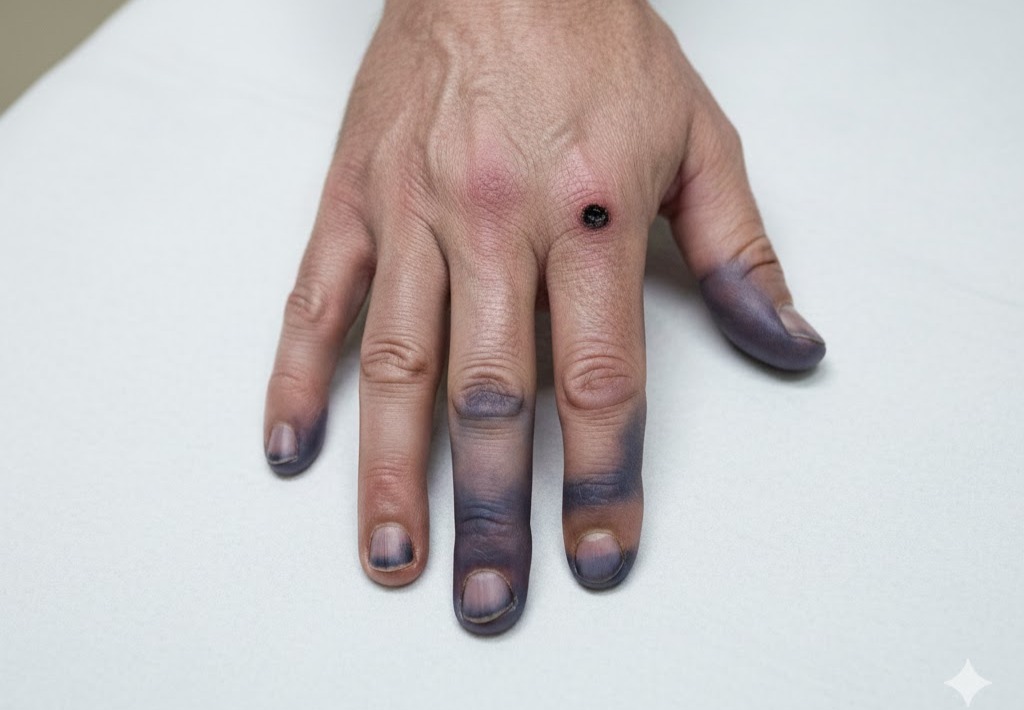
While smoking carries countless risks, few are as uniquely and inextricably linked to tobacco use as Buerger’s disease, or thromboangiitis obliterans. This rare and devastating condition strikes at the arteries and veins that carry blood to the extremities, often leading to chronic pain, severe tissue damage, and amputation.
A Disease of Occlusion: What is Buerger’s Disease?
Buerger’s disease is a non-atherosclerotic, segmental, inflammatory condition that primarily affects the small and medium-sized blood vessels in the arms and hands and, most commonly, the legs. Unlike other vascular diseases related to fatty plaques, Buerger’s involves an inflammatory process that causes blood vessels to swell. This swelling eventually leads to the formation of blood clots, or thrombi, which completely or partially block the flow of blood. This occlusion prevents oxygen and nutrients from reaching the tissues, a state known as ischemia.
The disease typically manifests first in the hands and feet, particularly in the fingers and toes. Early symptoms often include Raynaud’s phenomenon, where the fingers or toes turn white, then blue, and finally red upon exposure to cold or stress. As the condition evolves, patients experience a deep, burning pain, often described as throbbing, in the affected limbs. This pain is particularly severe even when the limb is at rest, distinguishing it from claudication (pain during exercise). As the blood supply diminishes further, the skin may appear thin, shiny, and pale, and the pulses in the distal extremities become weak or absent.
Progression and Complications
The natural evolution of Buerger’s disease, if the cause is not eliminated, is grim. The persistent lack of blood flow eventually leads to ulceration and tissue death (gangrene). These ulcers are excruciatingly painful and difficult to heal due to the poor circulation. Once gangrene sets in, the tissue is irreversibly damaged, often turning black and necrotic.
The untreated or unaddressed progression of Buerger’s disease makes amputation a common and tragic outcome. The disease tends to advance segmentally, meaning an initial amputation may be followed by the loss of the limb above the joint (for example, the loss of the foot followed by the loss of the lower leg) as the disease climbs the vascular tree. It is a relapsing and remitting condition, meaning periods of remission can be followed by sudden, painful flares that require aggressive medical intervention.
Tobacco’s Irrefutable Causal Role
The connection between Buerger’s disease and tobacco is not merely correlational; it is causal. Nearly all patients diagnosed with this condition are active users of tobacco. The substances in tobacco appear to trigger a unique inflammatory and autoimmune reaction in genetically susceptible individuals, leading to the destruction of the blood vessel walls.
Critically, cessation is the only definitive treatment. There are no surgical or pharmacological cures for Buerger’s disease; all other medical interventions are only supportive or aimed at managing symptoms.
Nicotine Itself: Nicotine is the addictive component in tobacco, and it is a vasoconstrictor (it narrows blood vessels). While this vasoconstriction is certainly undesirable for someone with a vascular disease, there is no substantial evidence to suggest that nicotine alone, when administered in non-combustible forms (like patches, gums), initiates or sustains the inflammatory-occlusive process that defines Buerger’s disease. One case of a vaper of nicotine e-liquid who had smoked very little in the past has nevertheless been reported.
Treatment and the Absolute Necessity of Quitting Smoking
The management of Buerger’s disease is first and foremost about immediate and permanent cessation of all tobacco and nicotine use. Anything less guarantees the progression of the disease and the eventual loss of limbs.
Medical treatments focus on relieving pain and improving blood flow:
- Vasodilators: Medications can be used to try and widen the remaining healthy blood vessels.
- Pain Management: Due to the severity of the pain, strong analgesics are often required.
- Wound Care: Aggressive treatment of ulcers and infections is necessary to prevent the spread of gangrene.
- Sympathectomy: In some cases, a surgical procedure to cut nerves controlling vascular tone can be performed to attempt to increase blood flow, though its long-term efficacy is debated.
Nicotine Replacement Therapy: A Necessary Caveat
Given the absolute importance of quitting, the role of nicotine replacement therapy (NRT) in Buerger’s patients is a complex topic. Since nicotine itself is a vasoconstrictor, meaning it causes blood vessels to narrow, there is a theoretical concern that NRT could aggravate the underlying vascular constriction inherent in Buerger’s disease.
However, clinical consensus leans toward the understanding that the thousands of other toxins and combustion products in tobacco smoke are vastly more dangerous than medicinal nicotine alone. For patients with Buerger’s disease, the urgency of eliminating smoke exposure outweighs the theoretical risk of pure nicotine. Therefore, NRT is often cautiously used under strict medical supervision to aid cessation, but only as a short-term bridge to complete abstinence. NRT is considered a safer, temporary option compared to the lethal certainty of continued smoking. The message remains uncompromising: quitting completely and permanently is the patient’s only hope for saving their limbs and halting the disease’s deadly march. The temporary use of NRT is deemed acceptable to help achieve the ultimate goal: zero exposure to tobacco.
Reference:
Memon N, et al. Progression of Buerger’s Disease in the Absence of Conventional Tobacco Exposure: A Case of Vape Associated Disease. J Dermatol Res. 2025;6(2):1-3. https://doi.org/10.46889/JDR.2025.6205
Use the ‘Comments’ field below to share your experience with Buerger’s disease or to suggest improvement to this page.




Leave a Reply