

Smoking remains a scourge on public health and a major factor of healthcare costs, but the good news is that governments worldwide have effective and proven tools at their disposal to combat it. This article presents the ten most effective policy measures, backed by scientific evidence, that can significantly reduce smoking and save lives.
These policies work by either making smoking less appealing and accessible, or by empowering smokers to quit.
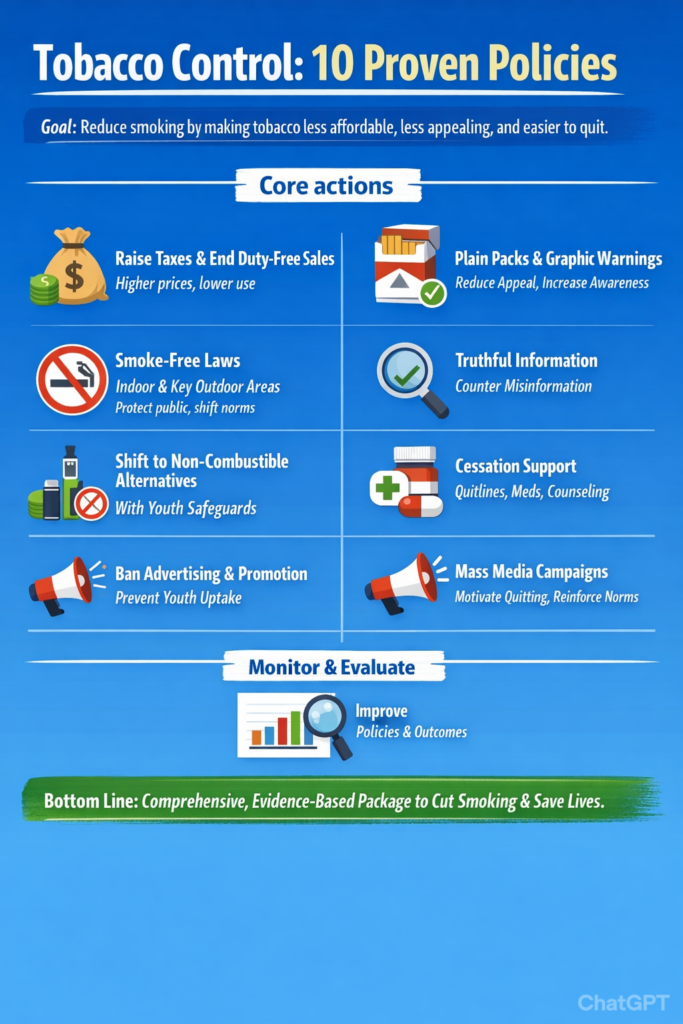
The Economic Approach: Making Tobacco Unaffordable
1. Raise Taxes on Tobacco Products
This is widely considered the single most effective policy for reducing tobacco consumption. Significant and regular increases in excise taxes make tobacco products less affordable, discouraging young people from starting and incentivizing current users to quit. For every 10% price increase, studies show a significant reduction in overall consumption, with the greatest impact seen among youth and low-income populations.
2. Eliminate Tax-Free and Duty-Free Sales
By removing tax exemptions for tobacco sold at airports and border crossings, governments close a loophole that allows products to be sold at artificially low prices. This policy maintains the price disincentive and prevents cheap tobacco from undermining local taxation efforts.
Clean Air and Social Norms: Protecting the Public
3. Implement Comprehensive Smoke-Free Laws
Laws mandating 100% smoke-free indoor public places, workplaces, restaurants, and bars protect non-smokers from the harms of secondhand smoke. Furthermore, these policies change social norms, making smoking less visible, less socially acceptable, and providing a powerful incentive for smokers to quit. Well-enforced bans have been shown to reduce smoking prevalence itself.
Extending smoke-free regulations to include outdoor areas—such as parks, beaches, school grounds, and hospital entrances—further de-normalizes smoking, protects children from exposure, and reinforces the public health message that smoking is not a typical behaviour.
Replace combustible products with smokefree products
4. Accelerate the replacement of cigarettes with non-combustible products
The tobacco market is undergoing rapid change, with cigarettes becoming an obsolete and inferior product, replaced by non-combustible alternatives.
It is essential to accelerate the transition of smokers to these new products, while implementing effective and proportionate policies to prevent young non-smokers from starting to use nicotine or tobacco.
5. Providing truthful information and combating disinformation
Misinformation about harm reduction and non-combustible nicotine and tobacco products is ubiquitous. Governments should support the creation and dissemination of truthful, balanced, and honest information on these topics.
Stopping the Next Generation: Eliminating Promotion and Appeal
6. Enforce Comprehensive Bans on Tobacco Advertising, Promotion, and Sponsorship (TAPS)8
Tobacco advertising recruits new users and undermines quit attempts. A total ban on all forms of TAPS—including in traditional media, online, at the point of sale, and through product placement or sponsorship—is highly effective at reducing tobacco initiation, particularly among youth.9
7. Mandate Graphic Health Warnings and Plain Packaging
Removing all branding, colours, and promotional elements from tobacco packaging (plain packaging) and requiring large, graphic health warnings that cover at least 50% (and ideally much more) of the pack surface reduces the product’s appeal and increases consumer awareness of the harms.10 This policy eliminates the pack as a marketing tool.11
Empowerment and Support: Helping People Quit
8. Provide Accessible and Affordable Smoking Cessation Services
While policies reduce demand, many addicted smokers need help to quit.15 Governments must invest in comprehensive cessation support, including:
- Toll-free national quitlines.
- Coverage for proven therapies (like NRT and prescription medicines such as varenicline and cytisine) and behavioral counselling through national health insurance programs.16
- Integrating ‘Ask, Advise, Refer’ protocols into routine healthcare.17
9. Run Sustained, High-Impact Mass Media Campaigns
Hard-hitting, professionally produced anti-tobacco media campaigns that clearly communicate the health risks and benefits of quitting are highly effective.18 These campaigns should be sustained over time and run at high frequency to ensure maximum reach and impact, reinforcing the message that help is available.
Monitor tobacco use and evaluate interventions
10. Monitor tobacco use and evaluate campaigns and policies
It is crucial to monitor tobacco and nicotine use in each population subgroup, and to assess the intended and unintended effect of all interventions, campaigns, policies, treatments and other anti-tobacco measures.
Use the ‘Comments’ field below to share your experience or to suggest improvements to this article.




Leave a Reply