
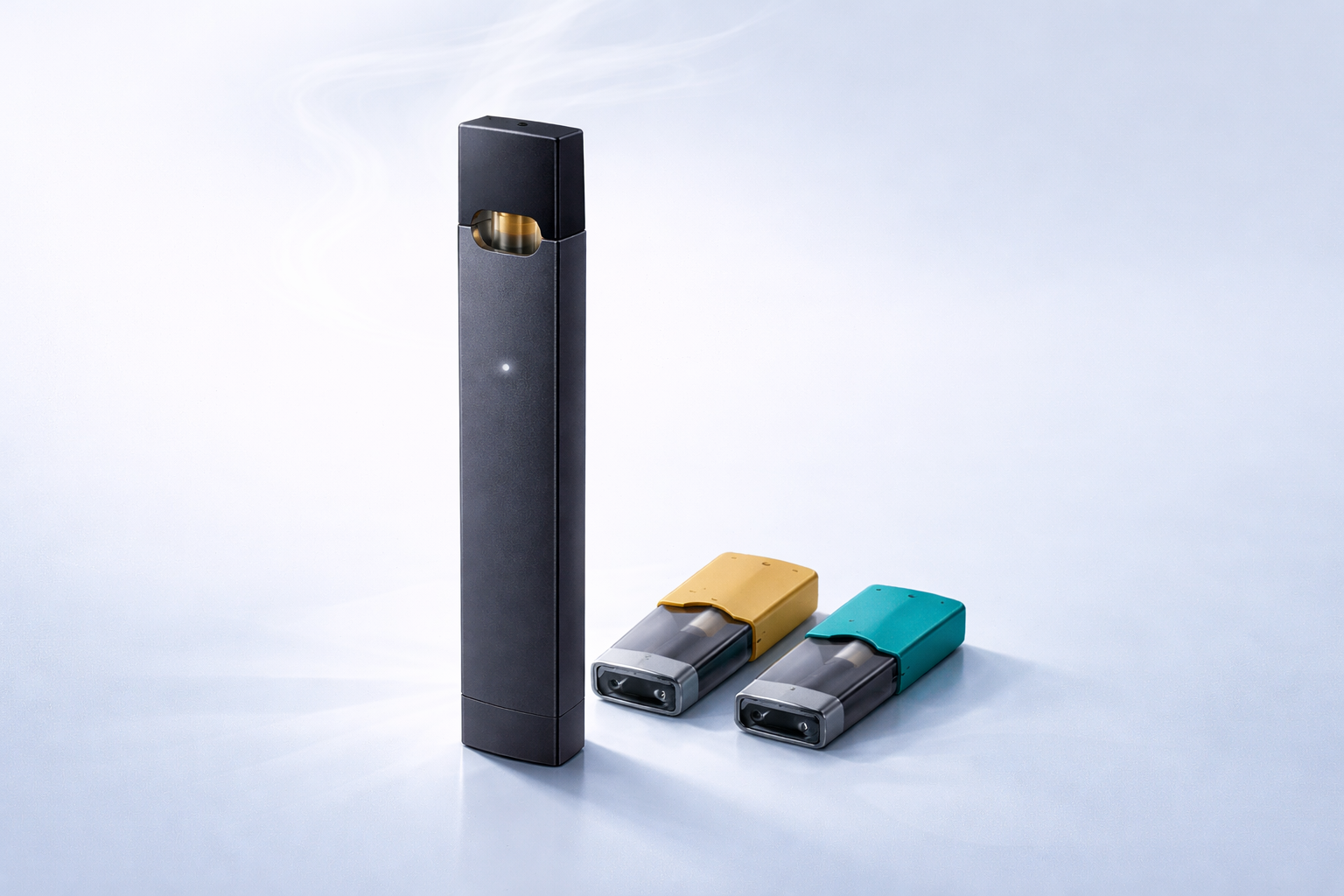
When the electronic cigarette market was still experimental, a small USB-shaped device launched in 2015 quickly transformed the landscape. That device was JUUL. Within a few years it dominated the American vaping market, triggered fierce public health debates, and became one of the most controversial nicotine products ever sold.
Today JUUL sits at the center of two competing narratives. One sees it as a harm-reduction tool capable of helping adult smokers move away from combustible cigarettes. The other views it as the symbol of a youth vaping epidemic. Understanding its role requires looking closely at how the product works, what it contains, and what the scientific and regulatory evidence actually shows.
What JUUL is
JUUL is a closed-system electronic cigarette consisting of two main components: a rechargeable battery device and a disposable cartridge known as a JUULpod. The pod contains a liquid made of nicotine, propylene glycol, glycerin and flavorings. A small heating element inside the device vaporizes the liquid, producing an aerosol that can be inhaled.
JUUL involves no combustion. Instead, the device generates a vapor containing nicotine and other substances. This difference is central to the harm-reduction argument often made by supporters of vaping: many of the toxic chemicals found in cigarette smoke are created during combustion.
The design of JUUL was intentionally minimalist. Roughly the size of a USB flash drive, the device can be charged directly using a small USB charger. Its discreet appearance and simplicity helped distinguish it from earlier, bulkier e-cigarettes.
One technical feature set JUUL apart from many earlier vaping products: the use of nicotine salts. This formulation allows relatively high concentrations of nicotine to be inhaled with less throat irritation than traditional “free-base” nicotine liquids. As a result, the device can deliver nicotine in a way that more closely resembles the sensation of smoking a cigarette.
How the device is used
Using a JUUL is intentionally straightforward. After charging the device, the user inserts a cartridge into the top of the battery. The device has no buttons or settings. It activates automatically when the user inhales through the mouthpiece, producing vapor almost immediately.
Each cartridge contains a fixed quantity of liquid and typically lasts several hundred puffs. For many users this corresponds roughly to the nicotine intake of a pack of cigarettes, although individual consumption patterns vary widely.
The closed-pod system means that users do not refill the device manually. When the liquid is finished, the cartridge is replaced.
Models and product evolution
Compared with other vaping brands, JUUL has released relatively few device models. The company has generally focused on refining a simple and recognizable design rather than offering numerous variations.
The original JUUL device, introduced in 2015, established the format that would become widely imitated: a slim rectangular body, a magnetic charger and a cartridge that snaps into place at the top.
A later version known as the JUUL C1 added Bluetooth connectivity. Through a smartphone application, users could locate a misplaced device or monitor usage patterns. The feature was presented as a way to help users track nicotine consumption.
More recently the company introduced JUUL2, a redesigned device with modified pods intended to reduce leakage and improve performance. Availability of this newer generation varies by market, and in many regions the original system remains the most widely recognized version.
Nicotine concentrations
One of the distinctive characteristics of JUUL products has been their relatively high nicotine content. In the United States the most common pods contain nicotine concentrations of 5 percent or 3 percent by weight, corresponding to roughly 59 mg/mL and 35 mg/mL respectively.
These levels are significantly higher than those found in many e-cigarette liquids. The use of nicotine salts makes these concentrations easier to inhale without the harsh throat sensation that would typically accompany such levels.
Regulations in other regions impose stricter limits. In the European Union, for example, nicotine concentrations in vaping liquids are capped at 20 mg/mL under the Tobacco Products Directive. JUUL pods sold in those markets therefore contain lower nicotine levels than their American counterparts.
Flavors
Flavors played a major role in the early growth of JUUL. In its first years on the market the company offered a wide range of varieties, including fruit and dessert flavors. These products quickly became some of the most popular options among users.
However, flavors also became the focus of intense criticism from public health advocates and regulators, who argued that sweet varieties were particularly appealing to adolescents.
In response to mounting regulatory pressure, JUUL removed most flavored pods from the U.S. market. The products currently authorized there are primarily tobacco-flavored and menthol pods, a restriction intended to reduce the appeal of the product to young people while still offering alternatives to adult smokers.
Can JUUL help smokers quit?
Whether JUUL helps smokers stop smoking remains a subject of debate. Some studies indicate that certain smokers switch completely from cigarettes to vaping products, thereby reducing exposure to the toxic substances produced by burning tobacco.
Regulators in the United States concluded that evidence submitted by the company showed that some adult smokers successfully transitioned away from cigarettes when using the device. On that basis, the product was considered to have potential benefits for smokers who would otherwise continue to use combustible tobacco.
At the same time, JUUL has never been approved as a smoking-cessation medicine. Unlike nicotine replacement therapies such as patches or gums, it is not marketed as a therapeutic product designed to treat nicotine dependence.
Youth vaping and the controversy surrounding JUUL
The rise of JUUL coincided with a sharp increase in youth vaping in the United States during the late 2010s. Within a few years the brand captured a large share of the American e-cigarette market, and surveys reported growing experimentation among adolescents.
Several factors likely contributed to the product’s popularity among teenagers. The discreet design made it easy to conceal, the nicotine delivery was strong compared with earlier vaping devices, and early marketing campaigns made heavy use of social media imagery that critics said resembled lifestyle advertising.
The surge in youth use triggered investigations, lawsuits and regulatory action. The company eventually agreed to large financial settlements with several U.S. states over allegations related to youth marketing.
These events turned JUUL into a central figure in the debate over vaping and youth nicotine use.
The gateway question
A key issue in that debate is whether vaping products act as a gateway to cigarette smoking among young people. Some studies have observed that adolescents who experiment with e-cigarettes are statistically more likely to try cigarettes later.
Researchers disagree about how this relationship should be interpreted. Some argue that nicotine exposure may increase the likelihood of later tobacco use. Others point out that the same underlying factors—such as sensation-seeking behavior or social influences—may lead young people to experiment with multiple products.
Because of these competing explanations, the gateway hypothesis remains a subject of ongoing scientific discussion rather than a settled conclusion.
Public health impact
Assessing JUUL’s overall impact on public health requires balancing potential benefits against possible harms. On one side of the equation is the possibility that some smokers may switch from combustible cigarettes to a product that does not involve burning tobacco. On the other side are concerns about youth nicotine addiction and long-term dependence on vaping products.
Public health authorities increasingly evaluate nicotine products at the population level, asking whether the number of smokers who move away from cigarettes outweighs the number of non-smokers who begin using nicotine.
The answer may vary across countries and over time as regulations, marketing practices and social attitudes change.
FDA authorization in the United States
JUUL’s regulatory path in the United States has been complex. After several years of review, the U.S. Food and Drug Administration authorized the marketing of the JUUL device and certain pods through its premarket tobacco product application process.
The authorization covers the device together with tobacco-flavored and menthol pods in specific nicotine strengths. According to the FDA, the available evidence indicated that these products could be considered “appropriate for the protection of public health,” a legal standard that weighs potential benefits for adult smokers against the risks to youth.
The agency emphasized that this authorization does not mean the product is safe. It simply allows the company to market the product legally under strict regulatory oversight, with continued monitoring of youth use and marketing practices.
A product that reshaped the nicotine debate
Few consumer products have had such a rapid and polarizing effect on the nicotine market. JUUL reshaped the e-cigarette industry, accelerated the debate over tobacco harm reduction and forced regulators to confront difficult trade-offs between protecting young people and providing alternatives for adult smokers.
Over a decade after its introduction, JUUL remains both a symbol of the promise of reduced-risk nicotine products and a reminder of the complex challenges they pose for public health.
Use the ‘Comments’ field below to share your experience with JUUL or to suggest improvements to this article.




Leave a Reply