Category: Quitting

  • Body Mass Index

    Body Mass Index

    Calculate your body mass index (BMI) using the calculator below to find out if you are overweight or obese. We also provide a brief but comprehensive and scientifically based explanation of the advantages and limitations of BMI below:


    Easily calculate your BMI:

    Body mass index (BMI) is a simple measure that takes into account your height and weight to determine whether you are at a healthy weight. Although this measure is not perfect, it can be useful for setting a goal (e.g., achieving a BMI of 24.9). The BMI score is calculated by dividing your weight in kilograms by the square of your height in meters, so the result is given in kg/m2. For example, a person weighing 70 kg and measuring 1.65 m tall has a BMI of 25.7.

    So, on the calculator, you would type: 70 / 1.65 / 1.65.

    Interpretation of results: BMI (in kg/m2):.

    • less than 18.5: underweight
    • 18.5 to 24.9: healthy weight
    • 25 to 29.9: overweight
    • 30 to 34.9: moderate obesity (class I)
    • 35 to 39.9: severe obesity (class II)
    • 40 and above: morbid obesity (class III)

    Limitations of BMI:

    BMI is not a perfect indicator of body fat, particularly in very muscular individuals, and it does not take skeletal mass into account. Furthermore, BMI is not linearly associated with disease risk or mortality. In fact, it is mainly the amount of abdominal fat that determines cardiovascular risk, rather than the total amount of fat. It is therefore advisable to also measure your waist circumference, which gives a good estimate of abdominal fat mass.

    BMI is an old measurement. It was proposed in the 19th century and was first used by insurers to estimate mortality risk. It is therefore primarily a descriptive index, but one that is currently used in a prescriptive manner. This becomes problematic when BMI is used to determine who can access drugs such as Ozempic or who can obtain reimbursement for them. Other methods should therefore be used, such as the Edmonton classification of obesity stages,(a) which uses several indicators to determine whether a person is obese. Ideally, direct measurements of body fat should be used.(b)

    You can also purchase a bathroom scale that uses an electrical induction system to indicate your weight, body fat, and muscle mass (price: starting at 25 USD or UK£).

    Also, you can measure your waist circumference, which is a good indicator of your amount of abdominal fat (and therefore your cardiovascular risk).


    Please rate this article by clicking on the desired number of stars:
    1 Star2 Stars3 Stars4 Stars5 Stars (1 votes, average: 5.00 out of 5)
    Loading...


    Use the Comment field below to share your experience with BMI and suggest improvements to this article, or write a testimonial about it.

    If you like this page, please mention it in a post on social media or link to it on your website. Thank you.


    References:

    a) Canning KL, Brown RE, Wharton S, Sharma AM, Kuk JL. Edmonton Obesity Staging System Prevalence and Association with Weight Loss in a Publicly Funded Referral-Based Obesity Clinic. J Obes. 2015;2015:619734. doi: 10.1155/2015/619734. (Lien).

    b) A. M. Prentice, S. A. Jebb. Beyond body mass index. Obesity Reviews. Volume 2, Issue 3, August 2001, Pages 141-147. (Lien). https://doi.org/10.1046/j.1467-789x.2001.00031.x

  • Measuring waist circumference

    Measuring waist circumference

    Measuring your waist circumference provides a quick and easy assessment of your abdominal fat, which is a good indicator of your risk of developing health problems such as diabetes, cardiovascular disease and high blood pressure. Here is how to measure your waist circumference and interpret the result:

    Check your measurement and your health risk:

    Body fat is distributed in two ways: under the skin and in the abdomen. It is mainly abdominal fat that is associated with a higher risk of disease and mortality. Measuring your waist circumference provides a simple, inexpensive, and reliable estimate of your amount of abdominal fat.

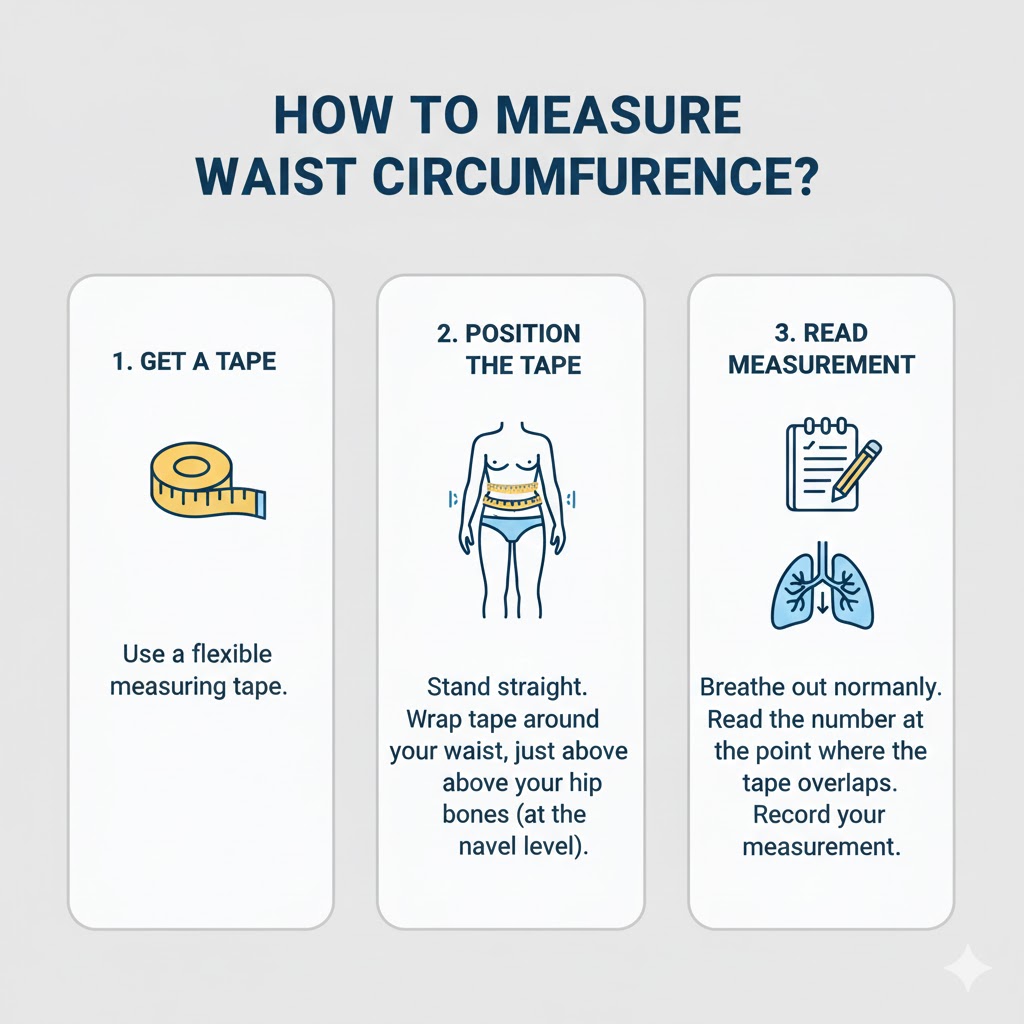
    Here’s how to measure your waist circumference:

    • Get a flexible measuring tape (sewing tape measure), then locate the top of your iliac crest (the protruding bone on the side where your belt rests) on each side.
    • Stand up straight with your heels and toes touching the floor and breathe normally.
    • Wrap the tape around your waist, at the level of your two iliac crests and your navel, directly on the skin.
    • Make sure the tape is snug, not too tight, and that it forms a ring parallel to the floor.
    • Take the measurement after exhaling (= emptying your lungs). Write down the measurement and the date.

    Here is how to interpret the measurement result:

    Based on guidelines from organizations such as the World Health Organization (WHO) and various health agencies, here are the generally accepted thresholds for high risks and very high risks associated with waist circumference in adults:


    Waist circumference risk thresholds (PDF):

    SexRisk LevelWaist: cmWaist: Inches
    WomenHigh Risk≥ 80 cm≥ 31.5 in
    Very High Risk≥ 88 cm≥ 35 in
    MenHigh Risk≥ 94 cm≥ 37 in
    Very High Risk≥ 102 cm≥ 40 in

    Waist size and health consequences:

    If your waist circumference is greater than 94 cm / 37 in (men) or 80 cm / 31.5 in (women), this may indicate that you have excess abdominal fat. In this case, a change in lifestyle is recommended (eating better and exercising more), or medical treatment for overweight or obesity may be warranted.(a) Note that even if your body mass index (BMI) is within the normal range (below 25 kg/m²), your cardiovascular risk is increased if your waist circumference exceeds the above values.

    A waist circumference greater than 102 cm / 40 in for men and 88 cm / 35 in for women is one of the diagnostic criteria for metabolic syndrome. This syndrome includes several factors associated with an increased risk of cardiovascular disease, including: high blood cholesterol, sugar, and insulin levels, high blood pressure, inflammation, etc.

    A large waist circumference is also strongly associated with the risk of developing type 2 diabetes, even more so than body mass index (BMI).(a) A large waist circumference is also strongly associated with the risk of cardiovascular mortality, as well as the risk of death from all causes.(a)

    How to lose weight?

    By reducing your waist circumference, you increase your chances of avoiding diabetes, cardiovascular disease, or premature death.
    – Follow our advice for losing weight,
    – Consult a professional who may be able to prescribe treatment,
    – Get support.

    Please note:
    It is strongly discouraged to lose weight if you are underweight, i.e., if, as an adult, your BMI is less than 18.5 kg/m2.


    Please rate this article by clicking on the desired number of stars:
    1 Star2 Stars3 Stars4 Stars5 Stars (1 votes, average: 5.00 out of 5)
    Loading...


    => Also calculate your body mass index (BMI).


    Use the Comment field below to share your experience and suggest improvements to this article.

    Or write a testimonial about it.

    If you like this article, please share it on social media or on your website.


    Reference:

    a) Ness-Abramof, R. and Apovian, C.M. (2008), Waist Circumference Measurement in Clinical Practice. Nutr Clin Pract, 23: 397-404. https://doi.org/10.1177/0884533608321700


  • Health benefits of quitting smoking

    Health benefits of quitting smoking

    Quitting smoking is one of the single most important steps you can take to improve your health, regardless of your age or how long you’ve smoked. The benefits begin almost immediately and continue to increase over time. Here’s what you need to know about the benefits of quitting smoking, its effects on symptoms and health after 1 day, 1 week, 1 month, 1 year, and 10 years, including specific benefits for women and older smokers.

    Time After QuittingHealth Outcome/Symptom Effect
    20 MinutesCarbon monoxide level in your blood decrease already
    12 HoursThe carbon monoxide level in your blood drops to normal, increasing the oxygen in your blood.
    1 Day– Your risk of a heart attack begins to decrease.
    – Blood pressure continues to drop.
    – You have better breath (less odor) and you no longer smell like cold smoke.
    2-3 DaysYour sense of taste and smell improves.
    – Bronchial tubes start to clean, making breathing easier.
    – You already spared enough money to buy a book.
    1 Week– Energy levels increase.
    – You cough and expectorate less.
    2 Weeks to 3 Months– Circulation improves, and lung function increases (by up to 30% in some cases).
    – Walking and physical activity become easier.
    1 to 9 Months– Coughing and shortness of breath decrease as the cilia (tiny hairs that clean the lungs) regain normal function, offering a better protection against infectious agents.
    – The risk of respiratory infection decreases
    Sinus congestion and lung capacity continue to improve.
    1 Year– Your risk of coronary heart disease (heart attack) is half that of a smoker.
    – You have already saved enough money to treat yourself to two weeks of your dream vacation.
    5 Years– Your risk of stroke is reduced to that of a non-smoker.
    – Your risk of mouth, throat, and esophageal cancer is cut in half.
    10 Years– Your risk of dying from lung cancer is about half that of a person who is still smoking.
    – Your risk of bladder, kidney, and pancreatic cancers also decreases.
    – You saved enough money to by a new car
    15 Years– Your risk of coronary heart disease is nearly the same as that of a non-smoker.
    – Your risk of dying from almost any cause is almost the same as that of a non-smoker.

    Immediate & Long-Term Benefits

    Quitting smoking positively impacts nearly every system in your body, from reducing your risk of life-threatening diseases to improving your daily quality of life.

    General Benefits

    • Financial Savings: You will save a substantial amount of money that can be used for other enjoyable activities.
    • Improved Senses: Your senses of smell and taste will begin to return to normal, making food more enjoyable.
    • Better Appearance: The yellowing of your teeth and nails will stop, your skin will show fewer signs of premature aging/wrinkles, you will have better breath (less odor), and you will no longer smell like cold smoke.
    • Enhanced Social Life: You’ll be free from the hassle of needing to smoke, and you’ll protect your loved ones from secondhand smoke.

    Health and Timeline Benefits

    Your body starts repairing itself within minutes of your last cigarette.


    Specific Benefits for Women

    Women who quit smoking experience specific health benefits:

    • Reproductive Health:
      • Fertility improves, making it easier to conceive.
      • Quitting reduces the risk of premature births, low birth weight babies, and miscarriage.
      • If you’re already pregnant, quitting is the best thing you can do for the health of both you and your baby.
    • Contraceptive pill: it is dangerous to both smoke and take the pill. The associated risks (in particular thrombosis) start to decrease as soon as you quit smoking.
    • Nicotine affects the nervous system of fetuses and infants because it crosses the placental barrier and passes into breast milk.
    • The risk of sudden infant death syndrome is higher when parents smoke.
    • Compared to children of non-smokers, children of smokers are twice as likely to become smokers themselves, and they are also more affected by respiratory infections and asthma..
    • Hormonal Balance: Your estrogen levels gradually return to normal. Smoking can lead to earlier menopause (1–4 years earlier) and more severe menopausal symptoms; quitting helps mitigate this.
    • Cancer Risk: Your risk of cervical cancer drops to near that of a non-smoker within as little as five years.
    • Bone Health: Quitting helps protect against osteoporosis and reduces the risk of fractures.
    • Wrinkles: Sun exposure and smoking are the two main risk factors for wrinkles. By quitting smoking, you can improve the appearance of your skin.

    Specific Benefits for People Aged 65 or Older

    It is never too late to quit. Even long-term smokers who quit in their later years gain significant health advantages, often leading to a longer, more active life.

    • Longevity: Quitting at age 65 can still significantly add years to your life expectancy and improve quality of life. Even quitting at age 80 reduces the risk of dying from smoking-related diseases.
    • Cardiovascular Health: The rapid improvement in circulation and lower risk of heart attack are particularly vital for older adults, whose systems may already be under stress.
    • Cognitive Function: Smoking is a risk factor for dementia and Alzheimer’s disease. Quitting can preserve and improve cognitive function, including memory, attention, and processing speed.
    • Respiratory Function: Improved lung function is crucial for maintaining an active and independent lifestyle. Quitting helps enhance respiratory capacity and reduces the risk of respiratory infections.
    • Medication Efficacy: Smoking can interfere with how some medicines work. Quitting can ensure your medications work more effectively.

    Use the ‘Comments’ field below to share your experience or to suggest improvements to this article.


  • Weight gain

    Weight gain

    After quitting smoking, most people gain weight. Here we explain why this happens, how much weight people usually gain after quitting, the possibility of using nicotine medications to delay weight gain, and how to limit weight gain

    Why people gain weight after they quit

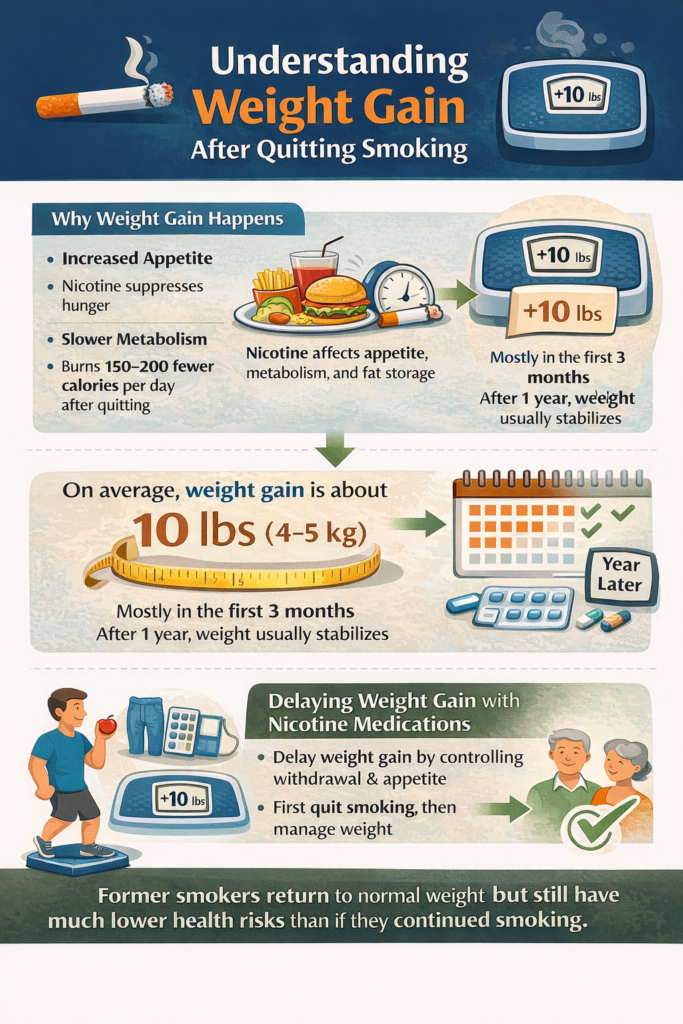
    There are three main reasons why your body tends to put on a few pounds when you stop smoking, linked to the effects of nicotine on your appetite and metabolism. Together, these three factors influence your calorie balance (intake/expenditure) and storage in the form of body fat.

    Increased appetite and cravings:

    Nicotine acts as a mild appetite suppressant. When you remove it, you may feel hungrier more often. Increased appetite is a well-documented nicotine withdrawal symptom.

    Many people also mistake the craving for a cigarette for a craving for food. Reaching for a snack is often an unconscious way to deal with the urge to put something in your mouth (the “hand-to-mouth” habit).

    Food, especially sugary or fatty treats, releases brain chemicals that feel good, temporarily replacing the pleasure you got from nicotine.

    Slower metabolism:

    Smoking actually speeds up your metabolism (the rate your body burns calories). A smoker’s body burns about 150 to 200 more calories per day than a non-smoker’s.

    When you quit smoking, your metabolism slows down to a normal, healthy rate, meaning you burn fewer calories at rest. If you don’t adjust your eating, those unburned calories can lead to weight gain.

    Changes in how your body handles fat:

    Nicotine affects how your body processes and stores fat. Quitting can lead to a shift in your body’s fat storage that contributes to weight gain.

    How much weight can you expect to gain?

    The good news is that the weight gain is usually modest. On average, most people who quit smoking gain about 10 pounds (4-5 kg). About one in ten people may gain more than 30 pounds, but this is the exception, not the rule. Most of this weight gain occurs within the first three months after quitting, and weight usually stabilises after about a year.

    Remember, even with a 10-pound gain, your risk of heart disease and cancer is still significantly lower than if you continued to smoke.

    How to use nicotine medications to delay and limit weight gain

    Increased appetite and weight gain are nicotine withdrawal symptoms, and you can delay them as long as you take a sufficient dose of nicotine. Of course, it is preferable to use nicotine medications (patches, gum, lozenges, sprays or inhalers) which are harmless. By ‘delay’, we mean that you first stop smoking, then after 3 months of using nicotine medications, you can stop the nicotine treatment and only then will you gain weight. This two-step strategy allows you to deal with one problem at a time, first quitting smoking and managing withdrawal symptoms, then managing your weight.

    Nicotine medications also make it easier to quit smoking by attenuating the other nicotine withdrawal symptoms: craving, iritability, depressed mood, anxiety, difficulty concentrating, difficulty sleeping.

    But you have to accept the fact that, for most former smokers, weight gain is permanent. On average however, former smokers weigh the same as people who have never smoked, and current smokers weigh less than non-smokers. This means that, on average, former smokers simply return to the normal weight of non-smokers of the same age and gender. However, some former smokers gain a lot of weight and end up weighing more than is normal for their age.

    We have created an entire website (Stop-Kilos.org) dedicated to helping people lose weight, so we invite you to visit the Stop-Kilos website for more information.

    Is weight gain always a health problem?

    Weight gain can lead to health problems mostly if you are overweight (body mass index, BMI>25 kg/m2) or obese (BMI >30 kg/m2) or if your waist circumference is >80 cm or >31.8 in (women) or >94 cm or 37 in (men). See our articles on how to measure your waist circumference and your body mass index.


    Please rate this article by clicking on the desired number of stars:
    1 Star2 Stars3 Stars4 Stars5 Stars (1 votes, average: 5.00 out of 5)
    Loading...

    Please use the Comments field below to share your experience and to suggest improvments to this page.


  • 10 rules to stop smoking

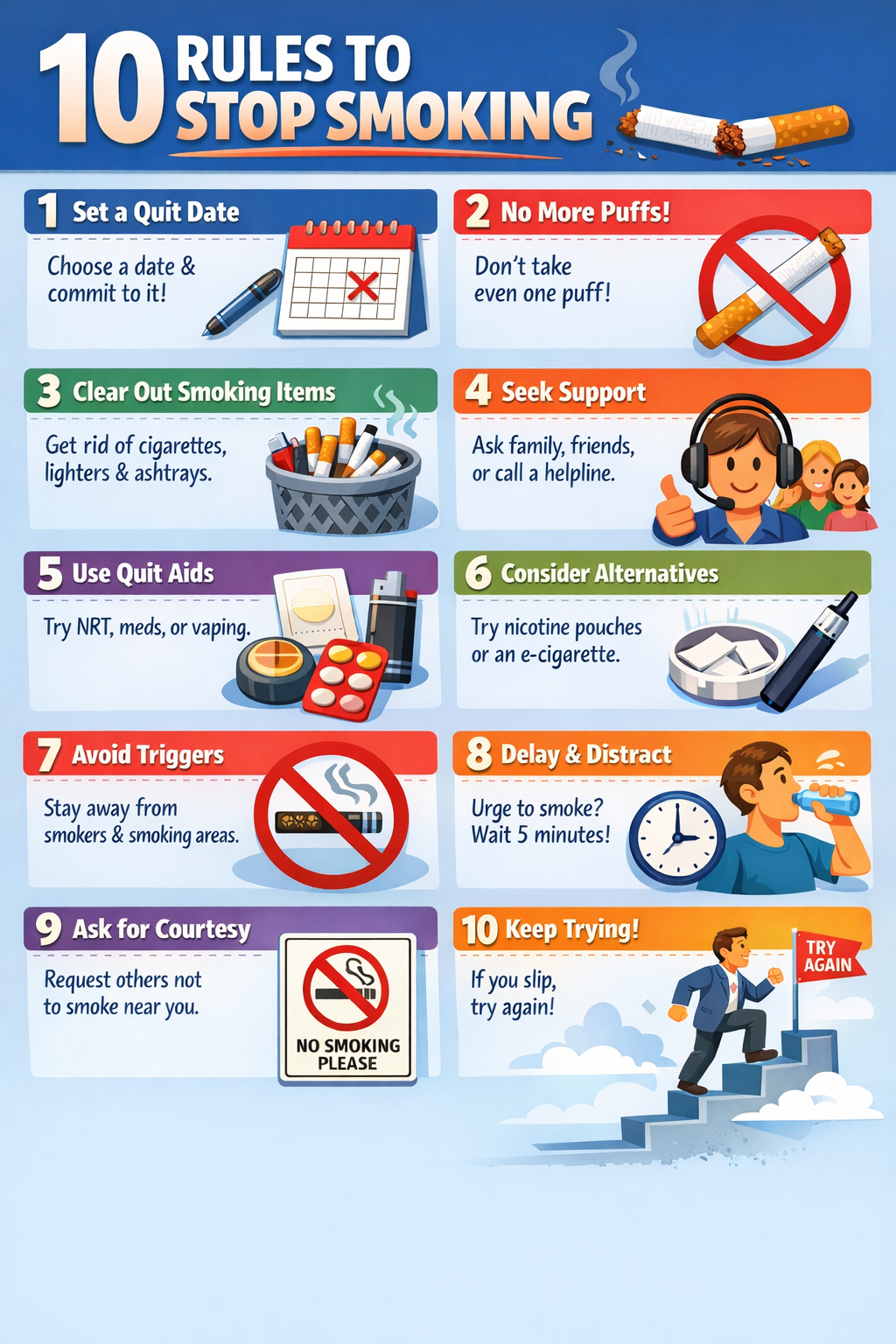
    Here are the 10 rules for quitting smoking (PDF):

    1. Make a firm commitment in writing, set a date to stop smoking in the next few days, and stick to it.
    2. Once you quit, do not touch a cigarette, not even one puff.
    3. Throw away all your tobacco, ashtrays, and lighters.
    4. Ask your family, friends, a doctor or a specialist clinic for help and support, or call a helpline.
    5. Follow a treatment programme: nicotine replacement therapy, bupropion, varenicline or cytisine, and use these medicines in conjunction with medical supervision.
    6. Or switch to another source of nicotine (e-cigarettes, nicotine pouches) or a tobacco product that is not burned (snus, heated tobacco for a few weeks).
    7. Avoid smokers and places where you used to smoke.
    8. If you have a strong urge to smoke, wait a few minutes—it will pass after 5 minutes—and take nicotine to relieve the urge (e.g., a patch or e-cigarette).
    9. Ask people to avoid smoking in your presence.
    10. Persevere, try again if you fail. You may need several attempts to succeed, but you will eventually get there.

  • Relapse

    Relapse

    Quitting smoking is often a difficult break from a powerful addiction. However, the real test of resilience often begins after the initial withdrawal phase. A relapse is not a failure, but a common obstacle—a sign that the addiction pathways in the brain are still active. To remain abstinent in the long term, you must not only stay away from smoking, but actively build a life in which smoking no longer plays a role. This transition requires practical strategies and an unwavering commitment.

    Identifying the Enemy: High-Risk Triggers

    The majority of relapses occur in predictable situations that act as powerful psychological cues. Understanding these personal triggers is the first line of defense. They fall broadly into four categories:

    1. Social Triggers: Being around other smokers is perhaps the most immediate danger. Attending a party where everyone steps outside for a smoke break or going to a bar where smoking is allowed can easily compromise resolve.
    2. Emotional Triggers: Stress, anxiety, boredom, anger, sadness, or even a celebration can all signal the brain that it needs the soothing or stimulating effect of nicotine. For example, the former smoker who always reached for a cigarette after a heated argument with a spouse must have a replacement plan ready before the next disagreement even begins.
    3. Routine Triggers: These are the habitual pairings—the ritualistic moments in the day tied to a cigarette. The first cup of coffee in the morning, the end of a meal, or getting into the car are all prime examples. These triggers are the most ingrained and require consistent, active substitution.
    4. Craving and other nicotine withdrawal symptoms: a very strong urge to smoke (craving), being in a bad mood (sad or depressed, angry, irritable, impatient or agitated, anxious or nervous, rapid mood swings), poor sleep (insomnia), difficulty concentrating, increased hunger and weight gain. But quitting smoking also brings about a rapid improvement in smell and taste. These symptoms are alleviated by nicotine replacement therapy.

    The Escape Plan: Avoidance and Substitution

    To successfully navigate these high-risk moments, preparation is key. Avoidance is the simplest tactic for the immediate term. For instance, if a specific coffee shop was the regular smoking spot, the former smoker should temporarily change their morning routine, perhaps opting for tea at home or taking a different route to work.

    When avoidance is impossible, substitution becomes the main tool. This is where the commitment to a new behavior must override the old habit. If stress is the trigger, a five-minute substitution could involve deep-breathing exercises, a quick walk around the block, or texting a supportive friend. If the trigger is the end of a meal, the former smoker needs to immediately engage the mouth and hands with something else—brushing teeth right away, chewing nicotine gum, or eating a piece of hard candy. The crucial action is disrupting the old routine instantly.

    Navigating Cravings: The Four D’s

    Cravings, even months after quitting, are intense but short-lived. They typically peak within three to five minutes. Former smokers need a repertoire of rapid response mechanisms to survive this brief window of desire. In addition to taking a nicotine gum of lozenge, experts recommend the “Four D’s” strategy:

    • Delay: Wait it out. Tell oneself, “I will wait five minutes and see how I feel then.” By delaying, the intensity often subsides before the person gives in.
    • Deep Breathe: Take ten slow, deep breaths. This not only distracts but also helps manage the anxiety often associated with the craving.
    • Drink Water: Sip a glass of water slowly. The physical act engages the mouth and provides a minor distraction.
    • Do Something Else: Immediately change activities. If one is sitting, they should stand up and move. If they are talking, they should shift the topic. A quick distraction breaks the mental focus on the craving.

    Weight Gain

    Many former smokers gain a few pounds after quitting smoking. Weight gain can be delayed by using nicotine replacement products (patches, gum, tablet). This way, you can tackle one difficulty at a time: first, you quit smoking, then you use nicotine replacement products for a few months, and only when you stop using these products will you possibly gain weight.

    The Relapse Management Protocol

    The ultimate mistake is to treat a single slip as a total failure. A single cigarette is a slip, not a surrender. The danger lies in the self-defeating mindset that follows, leading to the full return to regular smoking.

    A successful relapse management protocol requires compassion and immediate action. If a former smoker has a cigarette, the focus must be on what happened just before that moment, identifying the trigger (Was it alcohol? Stress? A specific person?) and analyzing what defensive measure was skipped. The goal is to learn from the mistake and immediately recommit to the quit effort, disposing of any remaining cigarettes and reinforcing the substitution tactics for the next high-risk situation.

    Long-term success is built on the realization that abstinence is a continuous, conscious effort. It requires maintaining motivation, celebrating every smoke-free day, and understanding that managing the urge to smoke is a skill that improves, but never entirely disappears. Staying vigilant against the triggers is the true path to a permanently smoke-free life.


    Use the ‘Comments’ field below to share your experience or to suggest improvements to this article.